
5 popular dental procedures in 2026: implants, veneers, crowns, aligners and whitening
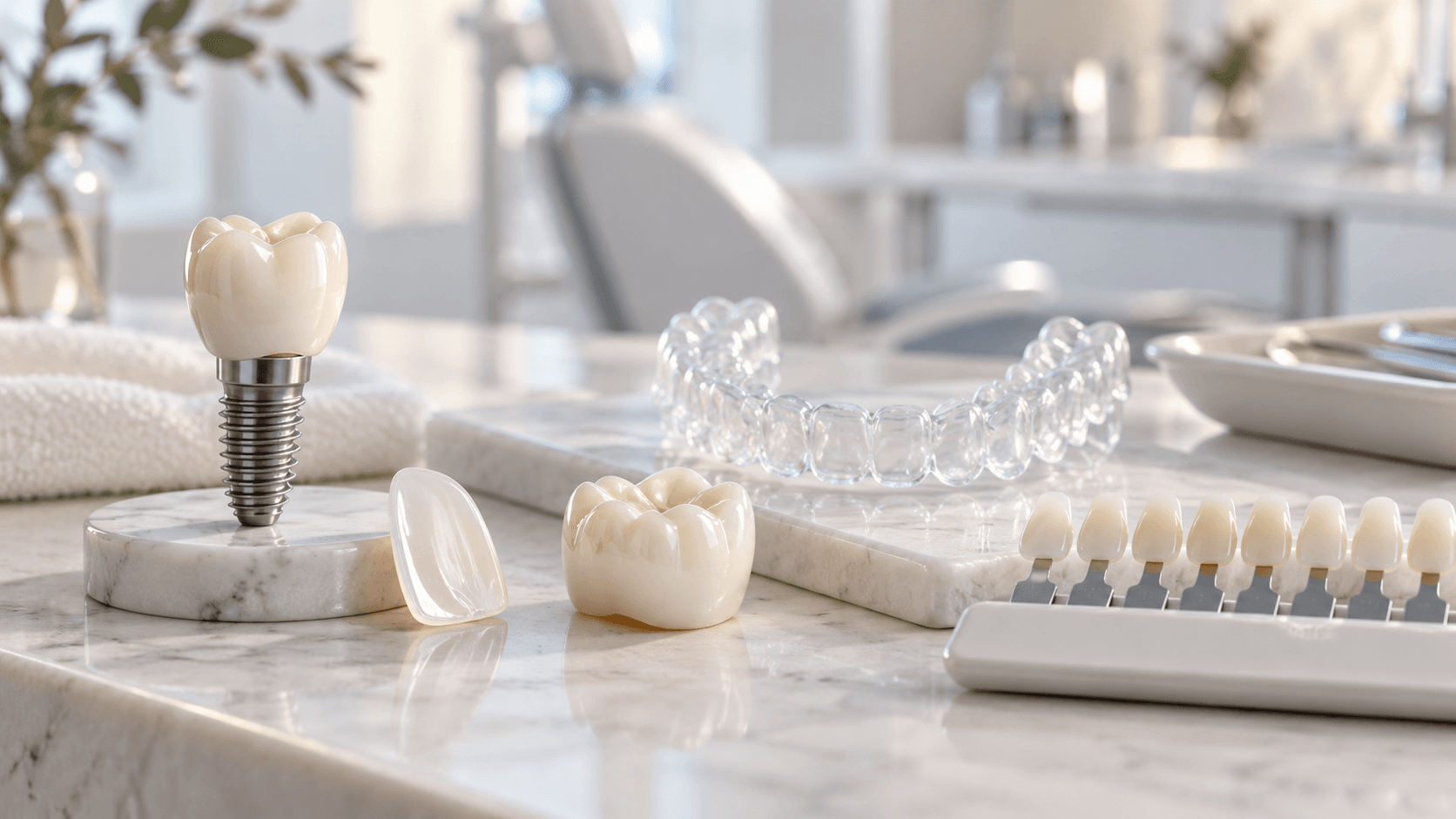
Modern dentistry can treat damaged teeth, replace missing teeth, improve the shape and colour of a smile, and change tooth positions without traditional braces.
However, procedures that appear to address similar problems have different indications. For example, a veneer cannot replace a crown on a severely damaged tooth, and whitening cannot change the shape of teeth or existing restorations.
Short answer: the procedures patients often consider for restoring and improving their smiles include dental implants, veneers, crowns, clear aligners and professional teeth whitening.
We explain what each procedure is for and who it may suit.
1. Dental implants
Purpose: replacing one or more missing teeth.
A dental implant is a structure placed in the jawbone that supports a future crown, bridge or full prosthetic restoration.
Implant treatment may be considered when:
- one tooth is missing;
- several teeth have been lost;
- a fixed restoration is needed instead of a removable denture;
- full rehabilitation such as All-on-4 or All-on-6 is being considered.
Before the procedure, the clinician assesses gum health, bone volume, the bite, medical history and the location of anatomical structures.
CBCT is often used to plan implant treatment, providing a three-dimensional image of the jaw.
What you should know
Not every patient can proceed directly to implant placement. If bone volume is insufficient, the following may be needed:
- bone grafting;
- a sinus lift;
- gum treatment;
- removal of a damaged tooth.
The precise treatment plan and number of stages are therefore determined after diagnostic assessment.
2. Veneers
Purpose: improving the appearance of front teeth.
Veneers are thin restorations bonded mainly to the front surface of a tooth.
They may be used to correct:
- colour;
- shape;
- small chips;
- gaps between teeth;
- asymmetry;
- certain minor changes in tooth position.
Ceramic materials are most commonly used, including lithium disilicate, also known under trade names such as E-max.
A 2025 systematic review and meta-analysis found high long-term survival rates for ceramic veneers. For lithium disilicate veneers, the pooled survival rate in the studies was approximately 96.8% with follow-up of up to 10.4 years.
An important consideration
Veneers work best when as much healthy enamel as possible can be preserved.
Another systematic review found higher survival and success rates for ceramic veneers bonded predominantly to enamel compared with cases involving substantial dentine exposure.
Before placing veneers, it is therefore important to assess how much healthy tooth tissue can be preserved.
3. Crowns
Purpose: restoring a severely damaged or weakened tooth.
Unlike a veneer, a crown covers much more of the tooth and is used both to improve appearance and to restore its function and structure.
A crown may be recommended when:
- a tooth is significantly damaged;
- there is a large old filling;
- a tooth has been weakened by previous treatment;
- its shape and chewing function need to be restored;
- an implant crown is needed.
Common materials include:
- zirconia;
- lithium disilicate;
- metal-ceramic;
- other dental ceramics.
A recent systematic review found high five-year survival rates for different types of single crowns. In particular, monolithic lithium disilicate and zirconia crowns showed results comparable to traditional metal-ceramic restorations.
Veneers or crowns?
In simple terms:
a veneer — when the main goal is aesthetic and the tooth is sufficiently preserved;
a crown — when a significantly damaged tooth needs restoration and protection.
The final decision depends on the condition of the individual tooth.
Start with a match, not a random list of clinics
Answer a few questions and see which factors matter for your case
4. Clear aligners
Purpose: gradually moving teeth and correcting the bite.
Clear aligners are a series of transparent removable trays, each of which gradually moves teeth according to a digital orthodontic plan.
Aligners may be used for:
- crowded teeth;
- gaps;
- certain bite problems;
- aligning teeth before aesthetic restoration.
The main advantage for patients is that the appliances are almost invisible and can be removed for eating and oral hygiene.
However, the result depends on proper planning and how consistently the patient wears the trays.
A 2024 systematic review evaluating different aligner wear protocols found that shortening the interval between tray changes does not always provide a statistically significant improvement in the effectiveness of tooth movement.
The orthodontist, rather than the patient, should therefore determine the aligner change schedule.
5. Professional teeth whitening
Purpose: lightening the natural colour of teeth.
Professional whitening is used when patients are happy with the shape of their teeth but want a brighter smile.
Whitening may be performed:
- in a clinic;
- using customised home trays under a dentist’s supervision;
- with a combination of methods.
What whitening cannot change
It is important to understand that the whitening agent works on natural tooth tissues.
It does not change the colour of:
- crowns;
- veneers;
- fillings;
- implant crowns.
If a patient is planning both whitening and new ceramic restorations, it is therefore best to discuss the sequence of procedures with the dentist in advance.
A brief comparison of procedures
| Procedure | Main purpose | When it is considered |
|---|---|---|
| Implants | Replacing a missing tooth | One or more teeth are missing |
| Veneers | Aesthetic correction | Colour, shape, chips, gaps |
| Crowns | Restoring and protecting a tooth | A significantly damaged or weakened tooth |
| Aligners | Straightening teeth | Crowding, gaps, certain bite problems |
| Whitening | Lightening teeth | Tooth colour is unsatisfactory, but the shape does not need changing |
Can these procedures be combined?
Yes. A comprehensive treatment plan often includes several stages.
Aligners → whitening → veneers
when tooth positions need to be aligned first, followed by work on colour and shape.
implant → crown
to restore one missing tooth.
Complex full rehabilitation may use implants, crowns and other prosthetic restorations together.
However, the clinician determines the sequence after diagnostic assessment.
- Treatment & materials
- Hotel nights
- Transfers
- Coordinator-translator
How to choose a procedure
Patients do not have to decide on their own: “I need veneers” or “I need implants”.
It is better to start with the problem:
- a tooth is missing;
- a tooth is damaged;
- the colour is unsatisfactory;
- there are gaps;
- the teeth are crooked;
- the entire jaw needs rehabilitation.
The dentist can then determine which options are truly suitable.
For example, depending on the situation, a gap between front teeth may be corrected with:
- composite bonding;
- veneers;
- orthodontic treatment.
The most invasive option is far from always necessary.
How Medikout helps you find treatment
Medikout is not a clinic. The platform helps patients find treatment options and clinics suited to their individual case.
The selection may take into account:
- the dental problem;
- photos;
- an X-ray or CBCT, if already available;
- the desired result;
- the treatment country;
- the budget.
Take the Medikout quiz and describe your situation — this helps identify clinics and treatment options suited to your case.
Frequently asked questions
Which dental procedure is best for a beautiful smile?
There is no single answer. Whitening may be enough to change colour, bonding or veneers may correct shape, and incorrectly positioned teeth may require orthodontic treatment.
Which is better: veneers or crowns?
Veneers are mainly used to improve the appearance of sufficiently preserved teeth. Crowns are needed when a tooth requires substantial restoration and protection.
Can an implant be placed in one day?
In some clinical situations, immediate implant placement or a temporary restoration is possible. However, the permanent restoration and complete treatment may require healing time.
Can gaps be corrected without veneers?
Yes. Depending on the size of the gap and the bite, alternatives may include composite bonding or orthodontic treatment.
Can crowns and veneers be whitened?
Whitening acts on natural tooth tissues and does not lighten existing ceramic restorations.
References
- PubMed — Survival and Complication Rates of Ceramic Laminate Veneers: A Systematic Review and Meta-Analysis
- PubMed — Clinical survival and complication rate of ceramic veneers bonded to different substrates
- PubMed — Efficacy of clear aligner wear protocols in orthodontic tooth movement: a systematic review
- PubMed — Systematic Review and Meta-analysis of Survival and Complications of Tooth-Supported Single Crowns