
What will hair transplant results look like: a natural hairline and density
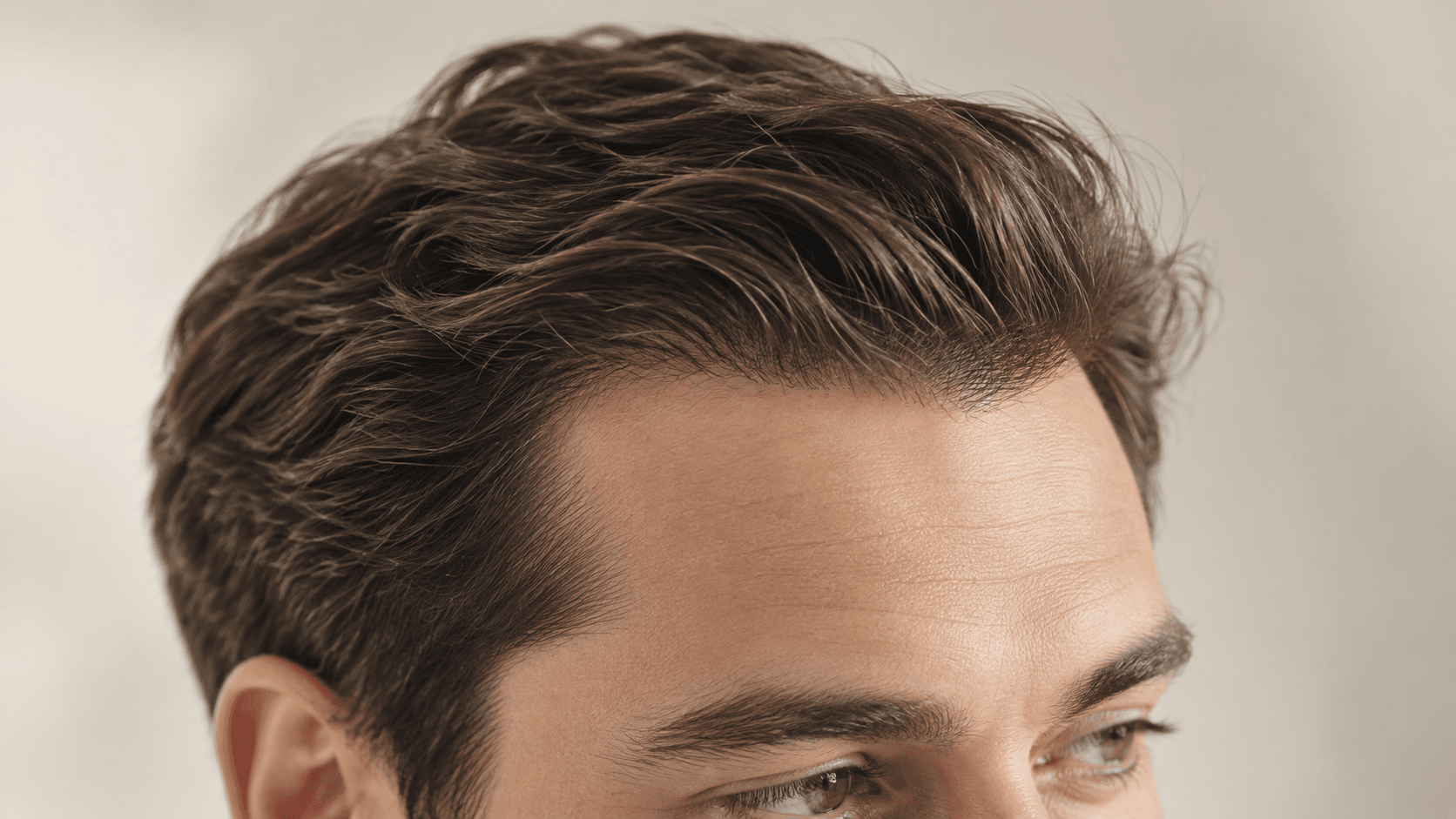
After a hair transplant, most patients want to understand two things: whether the hairline will look natural and how dense the result will be.
The answer depends on more than the number of transplanted grafts. The final appearance is influenced by the hairline shape, the direction and angle of hair growth, hair thickness, the contrast between hair and skin, the condition of the donor area and how the patient’s own hair loss progresses over time.
Short answer: a natural result after transplantation is not about the lowest possible or perfectly straight hairline, nor necessarily the maximum number of grafts. A hairline that suits facial features, age and the natural direction of hair growth looks best, while density is planned with the donor area’s resources in mind.
What determines how natural the hairline looks
The hairline is one of the most visible parts of a transplant result. Its design is therefore considered a key stage of surgical planning. Reviews on hair restoration emphasise that thoughtful hairline design directly influences how natural the aesthetic result looks. PubMed
The clinician considers:
- face shape;
- forehead height;
- the patient’s age;
- the characteristics of the previous hairline;
- the degree of hair loss;
- the donor hair reserve;
- the outlook for future alopecia.
The same hairline therefore cannot suit everyone equally well.
A natural hairline should not be perfectly straight
Natural hairlines have small irregularities, transitions and asymmetry.
A 2025 study specifically highlights that natural asymmetry in hair growth direction is normal, and absolute symmetry is not a prerequisite for a natural result. PubMed
An overly straight, geometric line may instead look artificial.
At the leading edge, a softer transition using individual follicular units is often created, with density gradually increasing farther back from the hairline. This principle helps avoid a “drawn-on” boundary. PubMed
Why hair growth direction matters
Even good density will not look natural if the hairs are implanted at the wrong angle.
During planning, the clinician considers:
- the natural growth direction;
- the angle at which a hair emerges from the skin;
- the characteristics of the temporal areas;
- the central part of the hairline;
- the whorl at the crown.
Classic work on hairline design describes growth direction and angle as key parameters in creating a natural frontal hairline. PubMed
The result therefore depends not only on the FUE or DHI technique, but also on exactly how the grafts were placed.
How dense will the hair be after transplantation?
A common expectation is to regain the same density as in adolescence.
This is not always realistic.
The donor area has a limited number of follicular units. The surgeon’s task is therefore to distribute them to create the most natural visual effect possible without depleting the donor reserve.
Medical literature describes dense packing, in which more than 30–35 follicular units per square centimetre are placed in certain cases. However, this approach does not suit every patient and depends on donor hair availability and other characteristics. PubMed
More grafts do not always mean a better result
Visual density is influenced by:
- hair shaft thickness;
- the number of hairs in a graft;
- hair colour;
- skin colour;
- whether the hair is straight or curly;
- the area that needs to be covered.
For example, thicker hair shafts create greater visual volume. A review on hair transplantation also notes that hair calibre has a significant effect on coverage and perceived density. PubMed
Two people with the same number of grafts may therefore need completely different strategies.
Start with a match, not a random list of clinics
Answer a few questions and see which factors matter for your case
How many grafts are needed for a natural result?
There is no universal number.
The number of grafts depends on:
- the size of the area of hair loss;
- the desired density;
- the initial density of the patient’s own hair;
- the quality of the donor area;
- hair shaft thickness;
- future progression of alopecia.
For example, a small adjustment to the frontal hairline requires a very different amount of work from restoring the frontal area + mid-scalp + crown.
The number of grafts should therefore only be determined after assessing photographs, trichoscopy or a consultation.
Why the hairline is not always placed as low as possible
A low hairline may look good immediately after surgery, but a transplant needs to be planned years ahead.
If hair loss continues, an excessively low or dense frontal area may use a substantial share of the donor resources, leaving fewer grafts for future procedures.
Recent reviews stress the importance of long-term planning and a conservative hairline design that remains natural as the patient ages. PubMed
A good plan therefore considers not only how the hair will look in one year, but also how it may look in 5–10 years.
When can the final result be assessed?
Hair transplant results do not appear immediately.
In the first weeks, transplanted hairs may shed — this does not mean the follicles have been lost.
Gradual new growth then begins. In most cases, the result is assessed over many months after the procedure, rather than after a few weeks.
Recent work on hair transplantation describes the long-lasting nature of the result and the need for postoperative monitoring and support for the patient’s own hair. PubMed
Early photographs therefore do not show the final density.
Can transplanted hair look completely natural?
Yes, modern methods can produce very natural results, but this does not depend on the technique’s name alone.
The result is influenced by:
- hairline design;
- appropriate graft selection;
- implantation direction;
- density distribution;
- donor area quality;
- the surgical team’s experience;
- appropriate patient selection.
A 2025 review notes that modern techniques, improved hairline planning and medication to support existing hair can produce long-lasting, natural results. PubMed
- Treatment & materials
- Hotel nights
- Transfers
- Coordinator-translator
What can make the result look unnatural?
The main causes include:
- an overly straight hairline;
- a hairline placed too low;
- incorrect hair angles;
- uniform density across the entire frontal area;
- overly coarse hairs at the very edge;
- inadequate planning for future hair loss;
- overuse of the donor area.
A clinic should therefore not be judged solely by the number of grafts it promises.
How to understand what result is possible in your case
The most accurate assessment comes after analysing the donor and recipient areas.
The clinician usually considers:
- the degree of alopecia;
- donor hair density;
- hair shaft thickness;
- the size of the transplant area;
- the natural hairline;
- age;
- family history of hair loss;
- previous transplants.
Realistic expectations are also important. One patient may achieve a very dense frontal area, while another may be better served by using fewer grafts and preserving part of the donor resources for the future.
How Medikout helps assess possible results
Medikout is not a clinic.
The platform helps find hair transplant clinics suited to the individual case.
A preliminary assessment may use:
- photos of the frontal hairline;
- photos of the temples;
- photos of the crown;
- photos of the donor area;
- information about when hair loss began;
- previous procedures.
This allows the clinic to estimate whether the patient is a transplant candidate, which area can be restored and how much work may be needed.
Take the Medikout quiz and add photos of your hair — this helps you receive clinic options and a preliminary assessment of your case.
Start with a match, not a random list of clinics
Answer a few questions and see which factors matter for your case
Frequently asked questions
Will the hairline look natural after transplantation?
It can, if the design suits facial anatomy, age and the natural direction of hair growth. A perfectly straight or identical hairline for every patient is not the goal of a high-quality transplant. PubMed
Can I regain the same density as before hair loss?
Not always. The donor area has limited resources, so the clinician balances density, coverage and the long-term plan.
Which matters more — the number of grafts or their placement?
Both matter. However, graft count alone does not guarantee a natural result. Direction, angle, hairline design and graft distribution are highly important.
Is a slightly asymmetrical hairline normal?
Yes. Natural hairlines and facial features are not always perfectly symmetrical. Slight asymmetry may even make the result look more natural. PubMed
When is the final density visible?
The final result is assessed months after transplantation, rather than immediately after surgery. Growth rates can vary between patients.
References
- PubMed — Hair Transplantation: State of the Art, 2025
- PubMed — Hairline design and frontal hairline restoration
- PubMed — Natural Asymmetry in Hair Growth Direction, 2025
- PubMed — Principles and techniques used to create a natural hairline
- PubMed — Dense packing: surgical indications and technical considerations
- PubMed — Hairline design in hair replacement surgery