
Temporary teeth after dental treatment abroad: what to expect
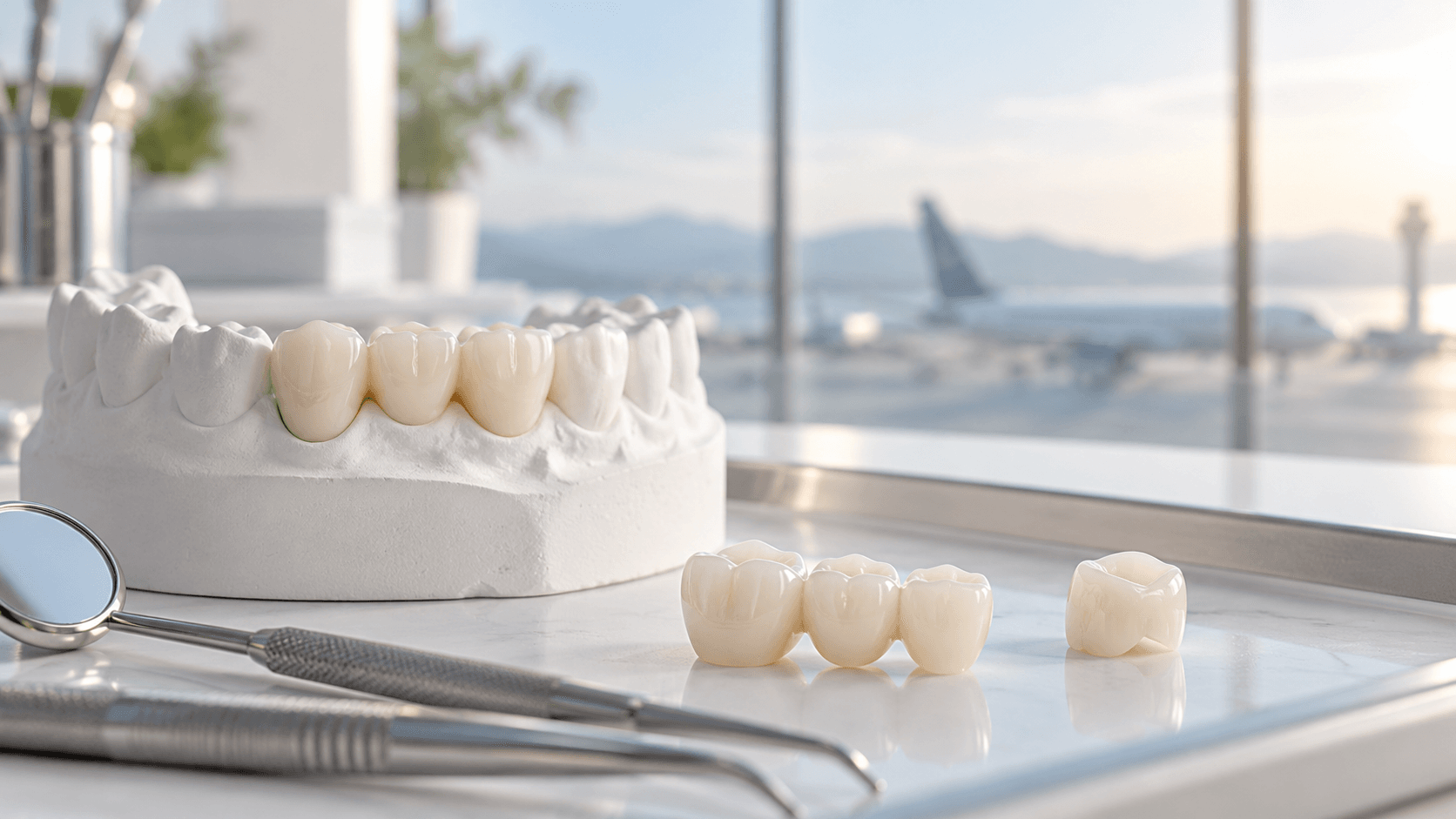
Temporary teeth are an interim restoration used before a permanent restoration is fitted. They may protect prepared teeth, maintain the appearance of your smile or be used during healing after implant placement.
If you receive treatment abroad, it is important to know before travelling whether you will have temporary teeth, how long you need to wear them and what to do if the restoration is damaged after you return home.
In brief: a temporary restoration may be a crown, bridge, removable denture or implant-supported restoration. It does not necessarily look or function like permanent teeth. Before booking, check whether it is included in the price, when it will be replaced with a permanent restoration and how follow-up will be arranged after you return home.
What are temporary teeth?
A temporary restoration is used between stages of treatment.
Depending on the procedure, it may:
- protect a prepared tooth;
- maintain aesthetics;
- help with speech and chewing;
- be used during healing after implant placement;
- help the dentist assess shape, bite or function before fitting a permanent restoration.
Dental literature describes temporary restorations as an important part of treatment planning, especially for implants and complex prosthetic treatment. PubMed
When might temporary teeth be fitted?
A temporary restoration may be needed if:
- teeth have already been prepared for crowns or veneers;
- the laboratory is still making the permanent restorations;
- the implants need a healing period;
- treatment takes place in several stages;
- the aesthetics and function of the dental arch need to be maintained temporarily.
Not every patient needs the same type of temporary restoration. It depends on the individual treatment plan.
Temporary teeth after implant placement
A permanent restoration is not always fitted immediately after dental implants are placed.
In some cases, patients may receive a temporary fixed or removable restoration while the implants heal.
This is particularly relevant to full-arch implant treatment, such as All-on-4 or All-on-6.
It is important to understand:
“I am going home with teeth” does not always mean “my treatment is complete.”
The restoration after the first trip may be temporary, with permanent teeth fitted later.
Before treatment, be sure to ask:
“Will the teeth I receive during my first trip be temporary or permanent?”
Start with a match, not a random list of clinics
Answer a few questions and see which factors matter for your case
How long do you wear temporary teeth?
There is no single timeframe for everyone.
The duration depends on:
- the type of treatment;
- how quickly the permanent restoration is made;
- the healing period;
- the condition of the gums;
- the implant protocol;
- the need for additional procedures.
A temporary crown between two dental appointments and a temporary full-arch restoration after implant placement may be worn for very different lengths of time.
It is therefore important to ask the clinic about your own treatment plan.
Do temporary teeth look like permanent teeth?
Not necessarily.
A temporary restoration may differ in:
- material;
- colour;
- translucency;
- shape;
- the method of attachment.
Its purpose is not always to fully replicate the final result.
If your appearance between treatment stages matters to you, especially for front teeth or work involving public speaking, tell your dentist in advance.
Can you eat normally with temporary teeth?
This depends on the type of restoration.
After some procedures, the dentist may recommend:
- softer foods;
- not chewing on a particular side;
- avoiding very hard or sticky foods;
- temporarily reducing the load on the restoration.
Do not rely on generic advice from the internet.
Ask your dentist:
“What will I be able to eat with temporary teeth, and will there be restrictions?”
How do you care for temporary teeth?
The rules depend on the type of restoration.
The clinic should explain:
- how to brush correctly;
- whether you can use dental floss;
- whether special care products are needed;
- which foods to avoid;
- what to do if the restoration becomes loose.
It is best to obtain these instructions in writing before returning home.
What if a temporary tooth breaks or falls out?
Do not try to glue, file down or force the restoration back into place yourself.
Contact the clinic and send:
- photos;
- a brief description of the problem;
- information about pain or discomfort.
The clinic should explain whether you can wait until the next scheduled appointment or need to see a dentist in your own country.
For treatment abroad, the NHS recommends checking in advance how follow-up care will be arranged after returning home. NHS
Are temporary teeth included in the treatment price?
Do not automatically assume they are.
Treatment packages may include different services at different clinics.
Check the estimate separately for:
- whether the temporary restoration is included;
- its exact type;
- whether necessary adjustments are included;
- whether the permanent restoration is included;
- whether replacement may require an additional payment.
- Treatment & materials
- Hotel nights
- Transfers
- Coordinator-translator
Is another trip needed to fit permanent teeth?
Sometimes, yes.
For implant treatment, the first trip may include surgery and temporary teeth, while the permanent restoration is fitted after a healing period.
In other cases, temporary and permanent restorations can be fitted during one trip, but at separate appointments.
The number of trips depends on the individual treatment plan.
What should you ask the clinic before travelling?
Before paying, request written answers:
- Will I have temporary teeth?
- What exact type of restoration will be fitted?
- Will it be fixed or removable?
- When will it be fitted?
- How long will I wear it?
- Is it included in the price?
- Will I be able to eat normally?
- What restrictions will there be?
- When will permanent teeth be fitted?
- Will a second trip be needed?
- What should I do if the restoration breaks at home?
- Who should I contact after returning?
Warning signs
Be cautious if:
- the clinic does not explain whether you will receive temporary or permanent teeth;
- advertising promises “permanent teeth in one day,” but this is not specified in the treatment plan;
- the temporary restoration suddenly becomes a mandatory additional charge after arrival;
- there are no care instructions;
- no one explains what to do if it breaks;
- no follow-up support is arranged after you return home.
How Medikout helps plan treatment
Medikout is not a clinic and does not independently decide which temporary restoration a patient needs.
The platform helps send your case to relevant dental clinics for a preliminary assessment.
This may require:
- photos of the teeth;
- a panoramic X-ray;
- a CT scan, if already available;
- information about missing teeth;
- previous implants or crowns.
Before booking, ask the clinic to confirm separately what you will receive after the first stage, what the permanent restoration will be, how many trips are needed and what is included in the price.
Complete the Medikout dental quiz and add photos or existing scans — this will help send your case to relevant clinics for a preliminary assessment.
Start with a match, not a random list of clinics
Answer a few questions and see which factors matter for your case
Frequently asked questions
Do temporary teeth mean treatment is complete?
No. A temporary restoration is often just an intermediate stage before the permanent one is fitted.
Are temporary teeth always fitted after implant placement?
No. This depends on the individual treatment plan, the patient’s condition and the dentist’s decision.
Can you eat with temporary teeth?
In many cases, yes, but there may be restrictions on hard, sticky or other foods, depending on the restoration.
Are temporary teeth included in the price?
Not always. Check this separately in the clinic’s estimate.
What if a temporary tooth falls out at home?
Contact the clinic for instructions. Do not glue or alter the restoration yourself.
Is a second trip needed to fit permanent teeth?
In some implant cases, yes. The exact schedule depends on your treatment plan.
This article is for information only and does not replace a dental consultation.