
Does a hair transplant hurt: the procedure and recovery day by day?
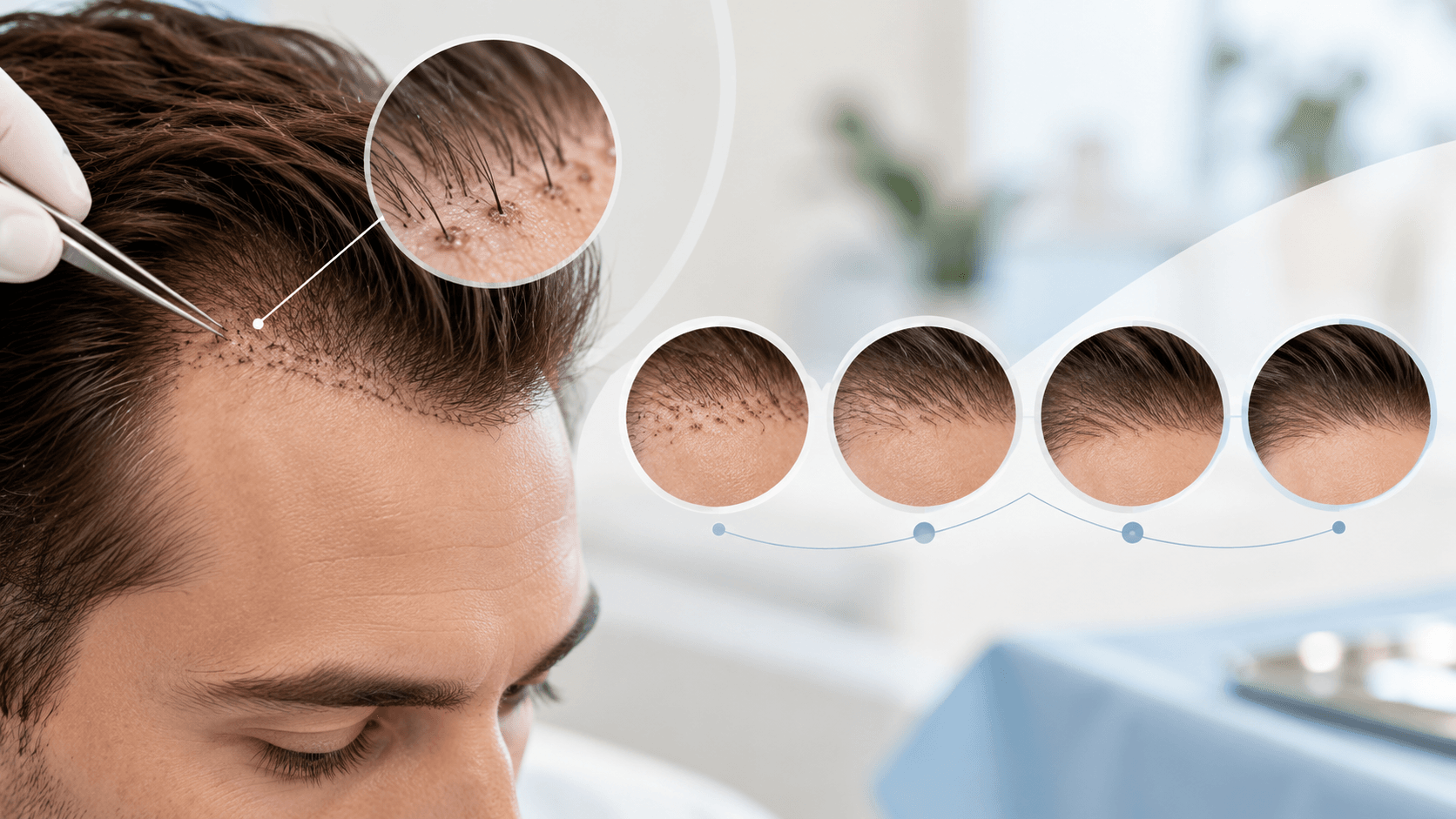
Short answer: hair transplants usually do not cause severe pain because they are performed under local anaesthesia. Administering the anaesthetic is often the most noticeable stage: patients may feel several injections, burning or pressure. Pain during the transplant itself is usually minimal.
Afterwards, moderate discomfort, scalp sensitivity, swelling and tightness are possible. These most often gradually decrease over the first few days.
The International Society of Hair Restoration Surgery (ISHRS) notes that most patients report mild postoperative discomfort, usually lasting one or two days. However, the intensity varies between individuals.
Here is what patients may feel during a hair transplant, how the first 10 days of recovery progress and which symptoms need a doctor's attention.
Does the hair transplant procedure hurt?
Most modern FUE hair transplants use local anaesthesia. Patients remain conscious, but the areas being treated temporarily lose pain sensation.
The procedure involves several stages.
1. Administering anaesthesia
This is one of the most noticeable moments. The doctor injects local anaesthetic into the donor area and the area receiving the hair.
Brief injection pain, burning or a feeling of pressure and fullness may occur.
Once the anaesthetic takes effect, the skin gradually becomes numb. If pain develops during surgery, tell the doctor immediately so they can check the anaesthesia.
2. Extracting grafts
During FUE, the doctor extracts individual follicular units — grafts — from the donor area, usually the back of the head.
With anaesthesia, patients mostly feel no pain, although they may notice touch, pressure or instrument movement.
3. Creating recipient sites and implantation
In the restoration area, the doctor creates sites for the grafts. The grafts are then implanted according to the planned growth direction.
With adequate anaesthesia, this stage also usually causes no significant pain.
However, no pain does not mean no fatigue. A transplant can last several hours, and remaining in one position for a long time can be difficult.
According to the NHS and ISHRS, hair transplants are usually performed under local anaesthesia, sometimes with additional sedation.
What patients feel after a hair transplant: day by day
After surgery, the anaesthetic gradually wears off. Sensitivity, tightness or moderate pain may then appear.
The following is an approximate FUE recovery timeline. Timing varies with graft count, skin condition and individual healing.
| Period | What patients may feel | What to know |
|---|---|---|
| Surgery day | Numbness, mild burning, tightness | Discomfort may appear when anaesthesia wears off |
| Day 1 | Moderate donor-area soreness and sensitivity | Protect transplanted grafts from friction |
| Day 2 | Tightness, sensitivity, swelling begins | Follow sleep and care instructions |
| Day 3 | Swelling may increase and scabs appear | Do not scratch or pick scabs |
| Days 4–5 | Swelling usually starts decreasing | Discomfort gradually eases |
| Days 6–7 | Itching may occur; scabs gradually soften | Wash hair only as instructed by the clinic |
| Days 8–10 | Pain is usually minimal; fewer scabs | Continue gentle care |
| Days 10–14 | Most scabs usually disappear | The skin continues healing |
This table describes a typical recovery pattern, not a mandatory schedule for every patient.
Day 0. Hair transplant day
Immediately afterwards, the scalp may remain numb from local anaesthesia.
As it wears off, burning, tightness or moderate pain in the donor area may appear.
On surgery day, rest, avoid physical exertion and do not touch the transplanted area.
The doctor should provide written guidance on care, medication, hair washing and sleeping position.
Day 1. Greatest sensitivity
During the first day, the donor area may be sore to touch.
Patients often describe tightness, mild burning or discomfort resembling skin irritation.
This is an expected tissue response after surgery.
If needed, the doctor prescribes pain medication. Do not select medicines or change doses yourself.
Day 2. Swelling may appear
On the second day, pain usually gradually decreases, but the forehead may swell.
Swelling sometimes extends towards the eyes. This does not necessarily indicate a complication: swelling after a hair transplant may peak around days 2–5.
Some patients are advised to sleep with their head slightly elevated for the first few nights. The doctor should explain the specific position.
Day 3. Scabs and tightness
Small scabs may be visible around transplanted grafts on the third day.
They form as part of natural healing.
The skin may feel tight and the donor area remain sensitive.
Do not pick scabs or scratch the skin, even if it itches.
Days 4–5. Discomfort decreases
For most patients, sensations gradually become less intense.
Swelling usually starts subsiding and the donor area begins healing.
The skin may still be red or sensitive. This does not necessarily mean a problem.
Even if you feel well, do not resume intensive exercise or change care routines on your own.
Days 6–7. Itching and healing
By the end of the first week, pain is usually minimal.
However, itching may occur: it is a common skin response during recovery.
Scabs gradually soften and start coming away.
The timing of the first hair wash differs between clinics and surgical protocols. Follow your own doctor's instructions.
Days 8–10. Returning to feeling normal
Most patients no longer have significant pain during this period.
There are fewer scabs, although redness or sensitivity may last longer.
People gradually return to ordinary activities. Restrictions on exercise, headwear and other activities may nevertheless continue.
The NHS states that transplanted grafts require particularly careful handling during the first two weeks.
Does pain differ between FUE and DHI?
FUE and DHI are often compared as separate transplant methods, although DHI usually involves FUE-style graft extraction; the differences mainly concern implantation.
Both approaches usually use local anaesthesia.
It is therefore not possible to claim that DHI is always less painful than FUE, or vice versa.
Patient sensations depend on anaesthetic effectiveness, surgery duration, treatment extent and individual sensitivity.
The technique's name alone does not guarantee less pain or faster recovery.
Start with a match, not a random list of clinics
Answer a few questions and see which factors matter for your case
What is normal after a transplant, and when should you contact a doctor?
Distinguish typical postoperative symptoms from signs of possible complications.
Usually expected symptoms include:
- mild or moderate pain in the first few days;
- skin tightness;
- temporary forehead swelling;
- redness and scabs;
- itching during healing;
- temporary numbness or increased sensitivity.
Contact a doctor if:
- pain is severe, increases or does not improve with prescribed medication;
- pus or other signs of infection appear;
- you develop a raised temperature;
- bleeding is significant or prolonged;
- redness or swelling rapidly worsens.
According to Cleveland Clinic, pain, swelling and scabs can be normal temporary effects, while severe pain, fever, marked redness or pus discharge need medical assessment.
If complications develop after returning home from a transplant abroad, do not delay seeking medical care where you are staying.
How can you reduce discomfort after a hair transplant?
The most important thing is to follow your doctor's individual instructions.
For a more comfortable recovery, patients are generally advised to:
- take only prescribed medicines as directed;
- avoid touching or scratching the transplanted area;
- follow sleeping-position instructions;
- wash hair as instructed by the clinic;
- temporarily avoid strenuous exercise;
- protect the scalp from injury and strong sun;
- attend follow-up examinations.
Do not apply ointments, oils, compresses or other products to the transplanted area on your own.
Even seemingly harmless actions may irritate the skin or damage grafts.
When can you return to work after a hair transplant?
Timing depends on the type of work and how you feel.
Some patients return after a few days if their work involves no physical exertion.
More time may nevertheless be needed for comfortable recovery and to reduce accidental graft injury.
The NHS notes that patients may need to plan up to one or two weeks off work.
If your work involves physical exertion, dust, heat or a protective helmet, discuss return timing separately with your doctor.
- Treatment & materials
- Hotel nights
- Transfers
- Coordinator-translator
Does it hurt when transplanted hair starts shedding?
No, natural shedding of transplanted hair shafts is usually painless.
Some transplanted hair may temporarily fall out a few weeks after the procedure. This common recovery stage is called shedding.
Losing a hair shaft does not necessarily mean losing the transplanted follicle.
New hair gradually begins growing after a few months.
According to the NHS, noticeable regrowth often begins around the fourth month, and full results may develop over 10–18 months.
How does Medikout help you prepare for a hair transplant?
Choosing a clinic and doctor is an important step before a transplant.
Find out in advance who performs the procedure, which anaesthesia is used, how pain is managed and who supports patients afterwards.
Medikout is not a clinic. We help patients find and compare hair transplant options abroad.
During selection, you can clarify important questions about the procedure, treatment conditions and postoperative support to prepare better for a consultation.
Medikout does not determine medical indications or prescribe pain medication. The doctor determines the final transplant and anaesthesia plan.
Planning a hair transplant but worried about pain or recovery?
Complete the short Medikout quiz to receive clinic options for a preliminary consultation.
Start with a match, not a random list of clinics
Answer a few questions and see which factors matter for your case
Frequently asked questions
Does an FUE hair transplant hurt?
FUE uses local anaesthesia, so the procedure usually causes no severe pain. Administering the anaesthetic may be the most noticeable moment.
Which day after a transplant is most painful?
Discomfort is often greatest during the first day, when anaesthesia wears off. Experiences vary, and swelling may peak on days 2–5.
How many days does the scalp hurt after a hair transplant?
Moderate pain and discomfort usually decrease during the first one to three days. Donor-area sensitivity may last longer. Severe or increasing pain needs medical assessment.
Are hair transplants performed under general anaesthesia?
Usually not. Local anaesthesia is most common, sometimes with sedation. The specific approach depends on patient condition and the procedure plan.
Can you sleep on your side after a hair transplant?
During the first few days, the doctor may recommend sleeping on your back with the head slightly elevated to avoid pressure on grafts and reduce swelling. Restriction duration depends on the transplant location.
When do scabs disappear after a hair transplant?
They usually gradually disappear within 7–14 days. Do not forcibly remove them: follow the clinic's hair-washing instructions.
Is an itchy scalp normal after a hair transplant?
Yes, moderate itching may be part of healing. If accompanied by marked redness, pain or discharge, contact a doctor.
Conclusion
Hair transplants are usually easier to tolerate than many patients expect. Local anaesthesia substantially reduces surgical pain, and postoperative discomfort usually gradually subsides during the first few days.
Nevertheless, a transplant remains surgery. Swelling, sensitivity, scabs and temporary numbness can be part of recovery.
Discuss pain relief beforehand, obtain clear care instructions and know whom to contact about unusual symptoms.
This material is for information only and does not replace a medical consultation.
References
- NHS — Hair Transplant. Procedure, anaesthesia, recovery and possible risks.
- ISHRS — After Hair Restoration Surgery. Pain relief and postoperative discomfort.
- Cleveland Clinic — Hair Transplant. Typical symptoms, recovery and complication signs.
- ISHRS — FUE: What Is It? FUE features and postoperative care.
- Complications in Follicular Unit Excision Hair Transplantation: Current Evidence and Practical Approaches. A scientific review of pain, swelling and other FUE complications.