
FUE vs DHI: Which Hair Transplant Method Should You Choose?
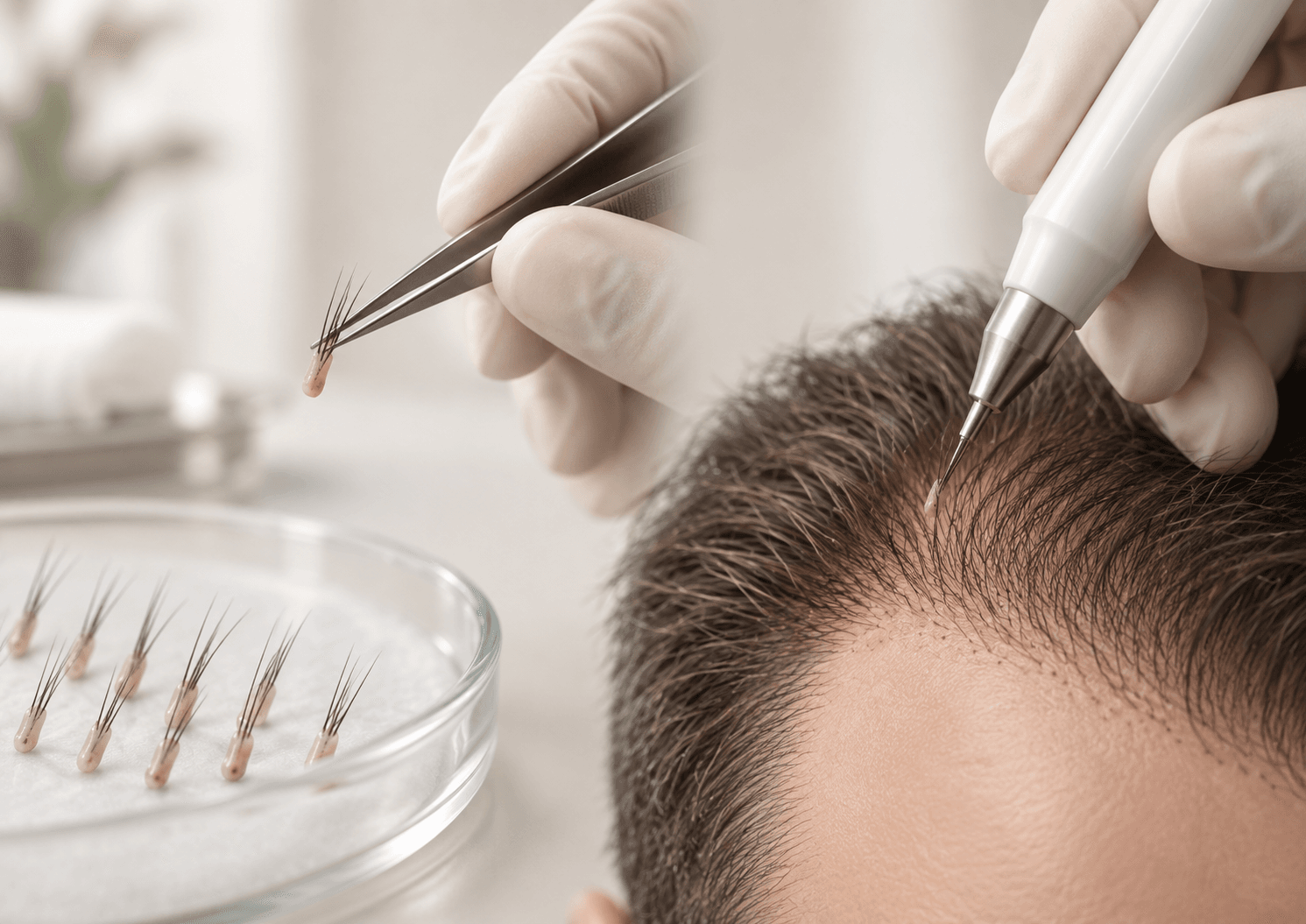
Patients often choose between FUE and DHI but do not always understand the difference. Both methods are modern, but they are intended for different purposes.
The short answer: FUE is better for large areas and speed, while DHI offers greater precision and density in specific areas.
What Are FUE and DHI?
FUE (Follicular Unit Extraction) is a method in which follicles are extracted individually, channels are then created, and the grafts are implanted into those channels.
DHI (Direct Hair Implantation) is a modification of FUE in which follicles are implanted immediately after extraction using a special Choi pen, without creating channels in advance.
FUE and DHI Compared
| Criterion | FUE | DHI |
|---|---|---|
| Implantation method | Channels first, then grafts | Direct implantation with a Choi pen |
| Number of stages | Two: channels and placement | One: puncture and implantation |
| Maximum per session | 4,000–5,000 grafts | 1,500–3,500 grafts |
| Angle control precision | Depends on the surgeon’s experience | Determined by the pen design |
| Survival rate | 90–95% | 95–97% |
| Procedure duration | Faster for large areas | Slower because of precision |
| Cost | Usually lower | Usually 15–30% higher |
When Should You Choose FUE?
FUE is suitable if:
- a large area needs to be transplanted, such as the entire frontal area or crown;
- procedure speed is important;
- the budget is limited;
- the maximum number of grafts is needed in one session.
When Should You Choose DHI?
DHI is suitable if:
- maximum precision is needed for the hairline or temples;
- density in specific areas is important;
- the patient wants less skin trauma;
- the budget allows for a more expensive method.
Start with a match, not a random list of clinics
Answer a few questions and see which factors matter for your case
Can FUE and DHI Be Combined?
Yes, the two methods are often combined:
- FUE for large areas such as the crown and back;
- DHI for the frontal hairline.
This provides a balance between speed, cost, and precision.
Frequently Asked Questions
FUE or DHI: which is better?
FUE is better for large areas, while DHI offers greater precision in specific areas.
Which method is more expensive?
DHI is usually 15–30% more expensive because of its complexity and precision.
Which method is faster?
FUE is faster for large areas, while DHI is slower because of its precision.
Can FUE and DHI be combined?
Yes, both methods are often combined for a better result.
What is the graft survival rate?
FUE: 90–95%; DHI: 95–97%.