
Hair transplant donor area: how can you tell if it is strong enough?
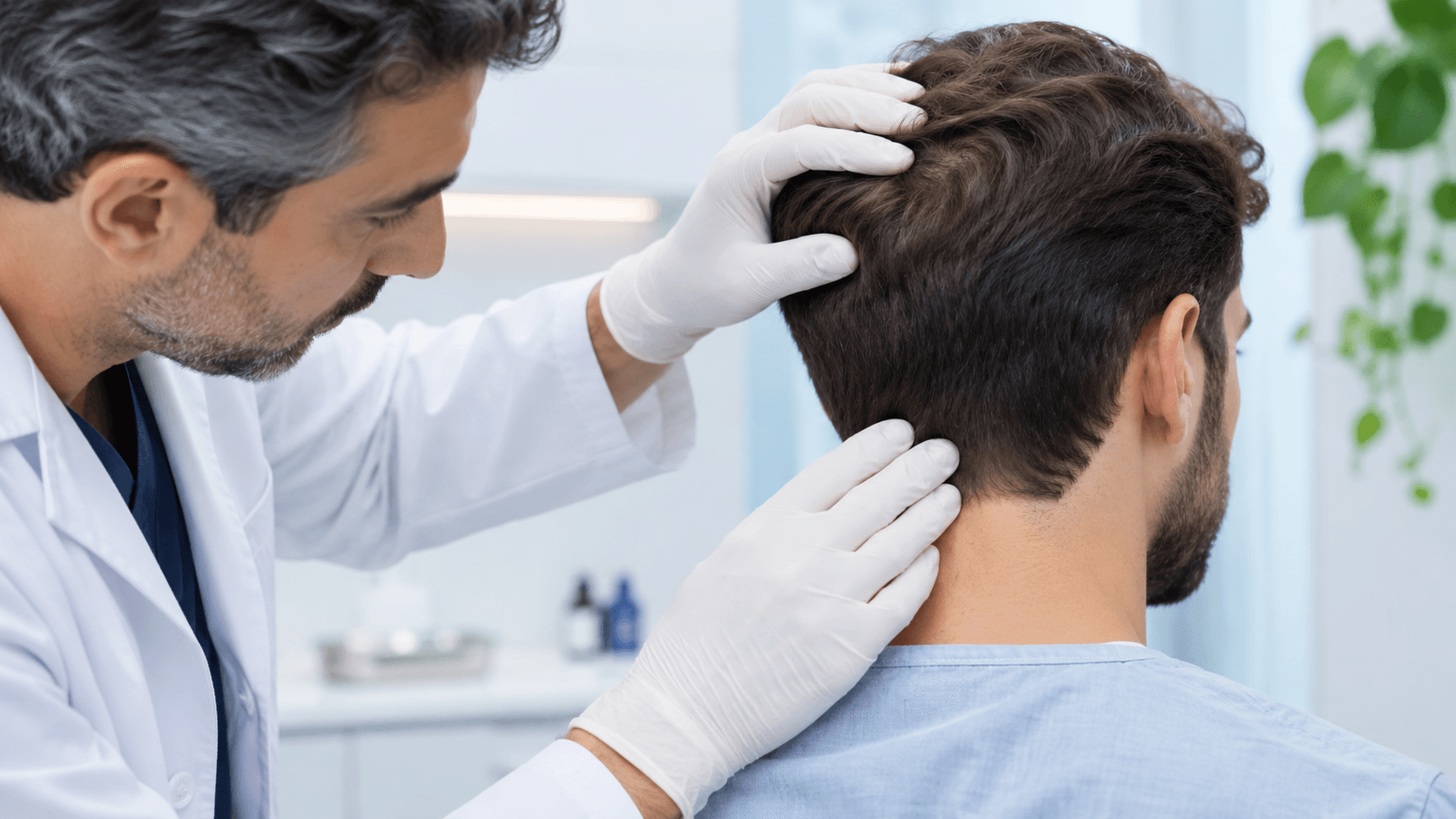
Before a hair transplant, assess not only the balding areas but the donor area too. The number and quality of available follicles determine how many grafts can be transplanted without excessive thinning at the back of the head.
How can you tell if your donor area is strong enough? Can you check it yourself, and what if hair at the back is sparse?
Short answer: a good donor area has sufficient density, suitable hair thickness and stable follicles without pronounced miniaturisation. The doctor assesses these through examination and trichoscopy. Thick-looking hair at the back is encouraging, but does not guarantee suitability.
What is a hair transplant donor area?
It is the body area from which follicles are taken for transplantation into balding areas.
The back and sides of the head are used most often. In androgenetic alopecia, hair there is generally more resistant to the processes causing progressive thinning.
During FUE or DHI, follicular units are extracted from the donor area and transplanted where restoration is needed.
One follicular unit, or graft, can contain several hairs. Thus 3 000 grafts do not mean 3 000 individual hairs.
The donor area must retain sufficient density after transplantation too.
5 signs of a good donor area
The doctor evaluates several parameters that together determine transplant possibilities.
1. Sufficient density
Density describes the follicular units or hairs per square centimetre of skin.
A larger reserve offers more possibilities. But not all follicles can be removed: some must remain to preserve natural density at the back.
2. Good hair thickness
Other factors equal, thicker hairs can provide a better visual impression of density after transplantation.
Two patients may need different graft counts for similar results because of thickness and texture differences.
3. No pronounced miniaturisation
Miniaturisation is progressive hair thinning characteristic of androgenetic alopecia.
If it affects the donor area, some transplanted hair may be unstable.
The doctor therefore checks follicular thinning even where hair looks dense.
4. Sufficient donor surface area
The safe harvesting area matters alongside density.
Its boundaries vary individually with the balding pattern and hair condition at the back and temples.
5. Follicle reserves for the future
Natural hair loss can continue after transplantation.
Planning therefore considers future loss as well as current needs.
Overusing the reserve in the first procedure can limit future treatment options.
Start with a match, not a random list of clinics
Answer a few questions and see which factors matter for your case
How is the donor area checked before transplantation?
Consultation with an experienced hair transplant specialist provides the most accurate assessment.
Trichoscopy, a magnified examination of hair and scalp, is a main diagnostic method.
It can identify:
- follicular-unit density;
- average hair thickness;
- miniaturisation;
- scalp condition;
- signs of disorders affecting transplantation.
A study in Skin Appendage Disorders supports trichoscopy for donor assessment and detecting hair disorders before transplantation.
The doctor may recommend further tests if needed.
Can photos assess the donor area? They can help a preliminary consultation but cannot precisely establish follicle density, miniaturisation or a safe graft count.
How many grafts can be taken?
There is no universal count.
Safe extraction depends on density, thickness, surface area, previous operations and predicted future loss.
For example, 4 000 grafts may be acceptable for one patient but excessive for another.
Taking too many follicles risks overharvesting: excessive donor depletion.
This can cause visible thinning, uneven density and restrict repeat transplantation.
Ask not only how many grafts will be transplanted but how many follicles will remain.
Can a weak donor area still support a transplant?
Sometimes, yes.
If insufficient for a large transplant, the doctor may restore only a specific area, such as the frontal hairline.
Other options include:
- reducing the planned graft count;
- staged transplantation;
- treating hair loss first if indicated;
- considering additional donor sites, such as the beard, in selected cases.
Beard and body hair have different texture and growth characteristics and do not fully replace scalp donor hair.
With severe depletion or unstable loss, the doctor may recommend postponing or avoiding transplantation.
- Treatment & materials
- Hotel nights
- Transfers
- Coordinator-translator
Does donor-area hair regrow?
After FUE, unextracted hairs keep growing, gradually restoring the area's familiar appearance.
However, an extracted follicle does not regenerate in the same place.
Small scar dots may remain after healing. Visibility depends on skin, technique and extraction extent.
Good planning usually preserves a natural appearance, though scarring and thinning cannot be completely excluded.
How does Medikout help assess transplant options?
For hair transplantation abroad, Medikout helps find a clinic that considers donor condition in treatment planning.
We help compare options, learn about FUE and DHI, obtain preliminary prices and arrange a free consultation with a partner clinic.
The specialist can explain required tests, donor reserves and realistic expectations.
Medikout is a clinic-selection platform, not a healthcare institution. A doctor decides suitability after examination.
Start with a match, not a random list of clinics
Answer a few questions and see which factors matter for your case
Frequently asked questions (FAQ)
How do I know my donor area is good?
Usually sufficient density, suitable thickness and minimal miniaturisation. Trichoscopy can confirm this.
Can I transplant if hair at the back is sparse?
Sometimes, but scope may be limited. It depends on stable follicles and the balding area.
Does the donor area regrow after FUE?
Unextracted follicles keep growing. Extracted follicles do not regenerate at their original sites.
Can beard hair be used?
In selected cases it provides additional donor hair. The doctor determines suitability.
Does age affect donor quality?
Age alone does not determine suitability. Follicle condition, loss pattern and overall health matter.
Conclusion
A sufficiently strong donor area is central to successful planning, but quality is more than apparent density at the back.
Density, thickness, growth stability and future reserves help determine transplant possibilities.
The best first step is professional donor assessment, not choosing the maximum advertised graft count.
This article is informational and does not replace medical consultation.