
How many grafts are needed for a hair transplant: how is it determined?
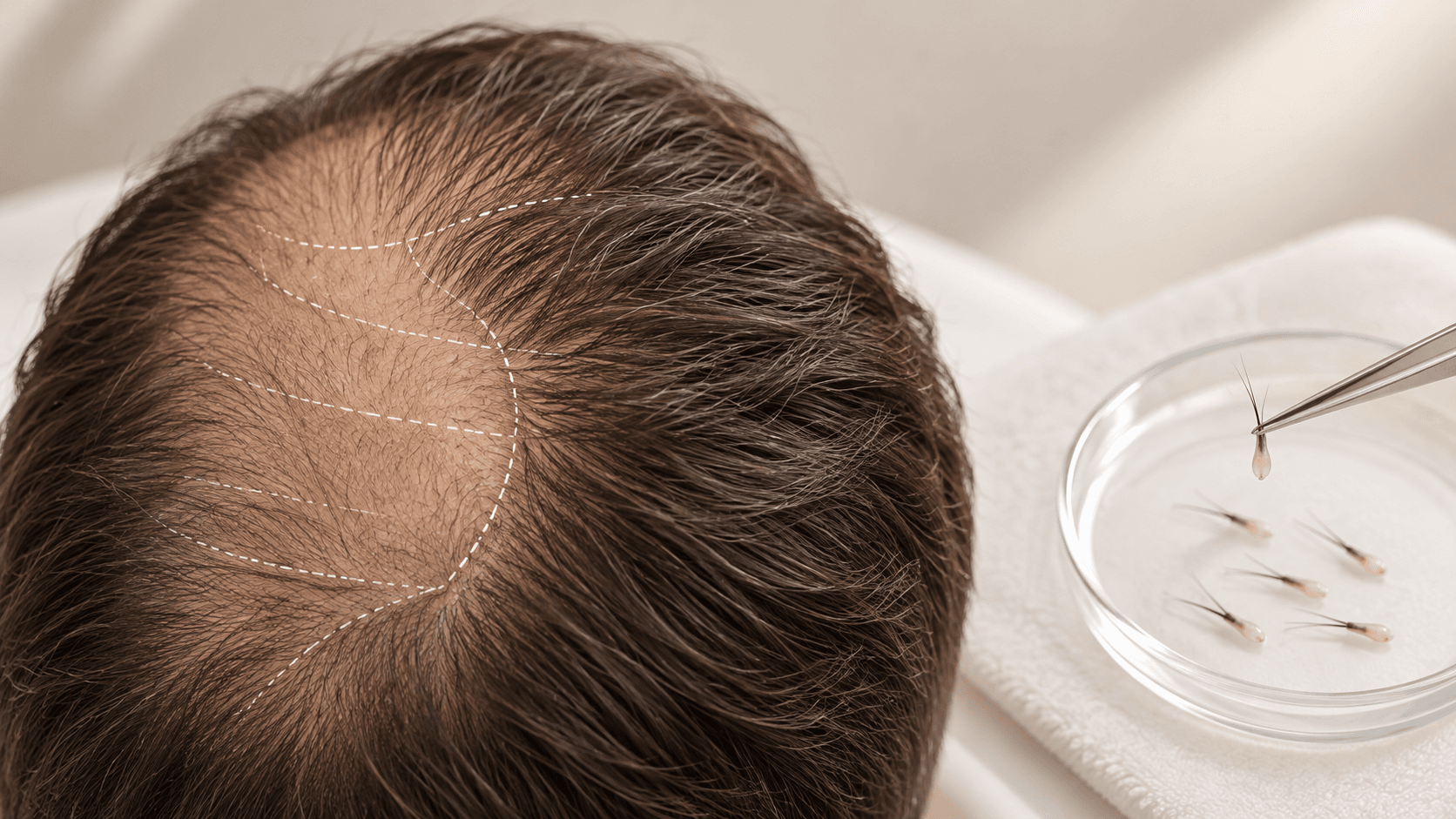
The number of grafts is one of the first figures patients want to know before a hair transplant. But there is no universal answer: 2 000 grafts may be enough for one case and insufficient for another. The doctor assesses the area of hair loss, desired density, condition of the donor area, hair thickness, number of hairs in each follicular unit and how hair loss may progress in the future.
In brief: what matters is not the maximum number of grafts, but the optimal number and their proper distribution. When comparing clinics, look beyond the figure in the offer: consider which areas will be restored, what the hairline will look like and how much donor capacity will remain after the procedure.
What is a graft?
A graft is a follicular unit extracted from the donor area and transplanted into an area of thinning or baldness. One graft may contain one, two, three or more hairs, so 2 500 grafts does not mean 2 500 transplanted hairs.
This is why the same number of grafts can produce different visual results in two people. Hair thickness and texture, the number of hairs in each follicular unit and how the surgeon distributes them in the transplant area all matter.
How does the doctor determine the number of grafts needed?
Planning starts with three main considerations: the area to be restored, the density that can realistically be achieved and the capacity of the donor area. These factors are always assessed together.
For example, a large area of hair loss may require many grafts, but if the donor area is not very dense, the doctor cannot simply extract any desired number. In this situation, priority areas must be identified and some donor capacity preserved for the future.
The transplant area
The larger the area of hair loss, the more grafts are usually needed. But even the term “hair transplant” can mean very different amounts of work: one person may only need small receding areas at the temples corrected, while another needs restoration of the hairline, frontal area and crown.
Two patients with roughly the same stage of baldness may therefore receive different plans. One may have a small area but want a denser hairline; the other may have a larger area, but the doctor may suggest distributing grafts more conservatively.
Start with a match, not a random list of clinics
Answer a few questions and see which factors matter for your case
What density is created during a transplant?
Natural hair density does not always need to be fully recreated to achieve a good visual result. Clinical literature includes approximate reference values of 25–40 follicular units per cm² for many areas, but this is not a universal standard.
Density depends on the specific area, hair thickness, number of hairs per graft, presence of existing hair and condition of the donor area. The calculation therefore cannot be reduced to “area × one standard figure”.
How many grafts are needed for the hairline?
The hairline requires particularly precise planning because it has the greatest influence on how natural the result looks. The doctor considers its height and shape, the width of the frontal area, hair growth direction and the patient's age.
Single-hair follicular units are often used at the very front to create a soft, natural transition. Grafts containing two or more hairs may be placed behind them for greater visual density. The exact number depends on the area and how low and dense the planned hairline will be.
Why can the crown need many grafts?
The crown often looks like a small area, but in practice it can require substantial donor capacity. This is due to its surface area and the natural spiral pattern of hair growth.
The doctor must also consider whether it would be more sensible to preserve some grafts for the frontal area. If the patient is young and hair loss is still progressing, using most of the donor supply solely on the crown may not be the best long-term strategy.
The donor area determines what is realistically possible
Donor capacity is limited. The doctor assesses hair density at the back and sides of the head, the number of hairs in grafts, hair thickness, signs of miniaturisation and previous transplants.
This is why the aim should not be to “collect as many grafts as possible”. Excessive extraction can leave the donor area visibly thinner and reduce the options for future procedures.
A good plan should answer not only “how many grafts will we transplant?” but also “how much donor capacity will remain after the procedure?”
Why do different clinics quote different graft counts?
It is entirely possible for one clinic to suggest 2 500 grafts and another 3 500. The difference does not necessarily mean that one of them is wrong.
The reasons may lie in different hairline designs, transplant areas, planned densities or approaches to the crown. One clinic may suggest restoring the front more densely and leaving the crown for the future; another may distribute grafts between both areas immediately.
Compare not just the figures, but the graft distribution map and the reasoning behind the plan.
- Treatment & materials
- Hotel nights
- Transfers
- Coordinator-translator
Why is there no exact “baldness stage = graft count” table?
Online tables give approximate graft counts for different Norwood stages, but provide only a very general guide. Even within the same stage, the area of hair loss, natural density, donor area characteristics and patient expectations can differ considerably.
| Situation | What affects the graft count |
|---|---|
| Hairline only | Its height, width and desired density |
| Hairline + frontal area | Surface area and presence of existing hair |
| Crown | Diameter of the area and priority of other regions |
| Extensive baldness | Donor supply and the possibility of several stages |
The stage of hair loss therefore helps describe the problem, but does not itself determine the exact number of grafts.
Can the graft count be determined from photos?
Good-quality photographs allow a clinic to estimate the area of hair loss and draw up a preliminary plan. Clinics usually request views from the front, above, both temples, crown, back of the head and side donor areas.
However, photos do not always allow precise assessment of donor density, hair thickness, miniaturisation or the number of hairs per graft. The figure quoted remotely may therefore change after an in-person examination.
Do more grafts mean a better result?
No. A high number alone does not guarantee a better transplant. Hairline shape, hair direction and angle, appropriate use of single- and multi-hair grafts and preservation of the donor area are just as important for a natural result.
It is therefore better to look for a clinic that can explain why you need a particular number and how it will be used, rather than one offering the most grafts.
What should you ask the clinic?
- how many grafts are planned;
- which areas they will be distributed across;
- whether the crown is included in the plan;
- what the hairline will look like;
- what density is planned;
- how the donor area was assessed;
- how much donor reserve will remain;
- whether the graft count may change after an in-person examination.
If you receive different offers, ask clinics to explain the reasoning behind each plan instead of simply comparing figures.
How can Medikout help?
If one clinic recommends 2 500 grafts and another 3 500, it is important to understand not only the difference in numbers, but also in the approach to the transplant itself.
Medikout is not a clinic. We help patients find and compare hair transplant clinics, considering the procedure plan, management of the donor area and graft distribution.
Complete the short Medikout quiz and add photos of your hair and donor area to receive personalised clinic options and a preliminary assessment.
Start with a match, not a random list of clinics
Answer a few questions and see which factors matter for your case
Frequently asked questions
How many hairs does one graft contain?
One graft may contain one, two, three or more hairs. Graft count and the number of transplanted hairs are therefore different measures.
Are 2 000 grafts enough?
It depends on the area. This number may be enough for a single frontal area, but not for a large area.
How many grafts are needed for the crown?
The exact number depends on the diameter of the area, desired density and how much donor capacity the doctor considers appropriate to use on the crown.
Why do clinics quote different numbers?
They may plan the hairline, density, treatment area and allocation of donor capacity differently.
Can the graft count change on the day of the procedure?
Yes. A preliminary photo assessment may be revised after an in-person examination and detailed assessment of the donor area.