
How to check a hair transplant clinic before booking?
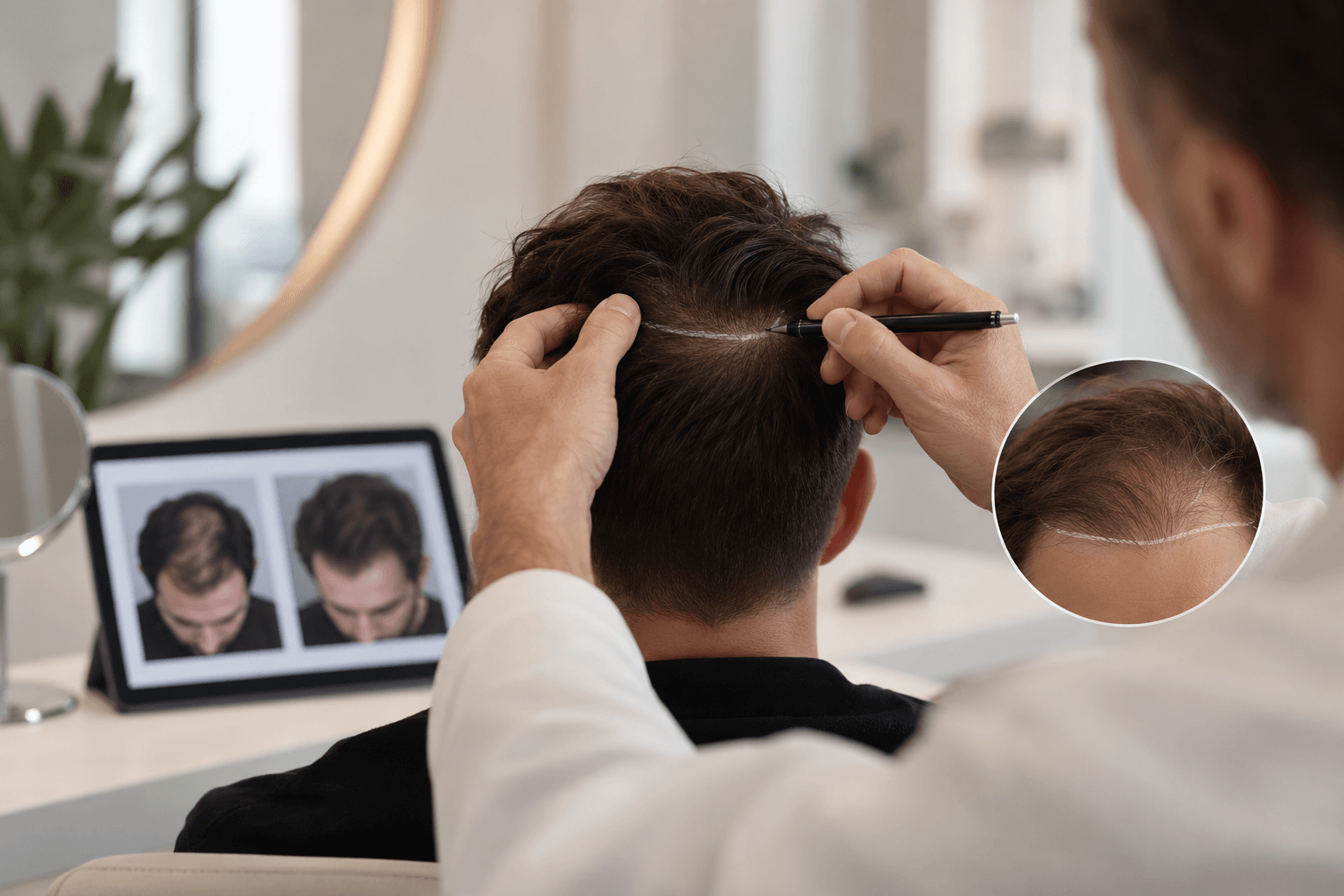
A hair transplant often looks simple: before-and-after photos, a graft count and a price on WhatsApp. But the essentials remain unseen: who will operate, whether the cases are genuine and who is responsible after you leave.
In brief: before booking, obtain the doctor's name and licence, clarify which stages they perform personally, and request a written graft plan with a donor assessment and cases like yours. If the clinic will not name the doctor, quotes graft counts without assessing the donor area or pressures you to pay urgently, take your time.
1. Who will actually perform the transplant?
This is the central question. Find out exactly who:
- conducts the consultation and designs the hairline;
- assesses the donor area;
- extracts grafts;
- makes incisions or channels for grafts;
- implants grafts;
- is responsible during and after surgery.
A team usually performs the transplant, which is normal. But roles must be known beforehand. ISHRS, the International Society of Hair Restoration Surgery, considers incisions, tissue extraction and recipient-site creation surgical steps that should be performed by an appropriately trained, licensed doctor under local rules. Delegation rules vary by country, so check those where surgery takes place.
Do not settle for “we have a team of specialists”. Before a deposit, request:
- the doctor's full name and specialty;
- licence or registration number;
- experience specifically in hair restoration surgery;
- the stages they will personally perform.
Ask directly: “Will this doctor personally perform my procedure, and which stages?” A famous doctor in advertising does not mean they will operate on you.
2. How do you check clinic and doctor licensing?
An attractive Instagram does not replace medical registration. Request:
- the clinic's full legal name and physical address;
- licence number and issuing authority;
- details of the responsible doctor.
Then check them yourself in the country's official register, through the health ministry or medical chamber. Labels such as “international”, “certified” and “award-winning” prove nothing.
Start with a match, not a random list of clinics
Answer a few questions and see which factors matter for your case
3. Is a transplant suitable for you?
Transplantation is not for everyone, and suitability should be assessed first. More challenging candidates include people with unstable progressive loss, inadequate donor supply, diffuse loss, active scarring alopecias, very young age, unrealistic expectations and certain medical conditions.
The conversation should not start with “You need 4 000 grafts, price €X”. The clinic needs the cause and stage of loss, donor status, previous transplants, age, medical history and medicines.
4. What should a written graft plan contain?
Before booking, request a preliminary written plan:
- approximate graft count and why;
- restoration areas and priorities: hairline, forehead, top and crown;
- donor-area assessment;
- proposed technique (FUE, DHI) and why it suits you;
- who performs the main stages;
- what is included and charged separately;
- limits of the expected result.
The donor area matters more than a record graft count. It is finite: overharvesting thins the back of the head and leaves less for the future. A count from one selfie is always approximate; the final plan is refined in person. An honest clinic says so upfront.
A technique's name does not guarantee natural results. “Hair Transplantation: State of the Art” describes patient selection, hairline design, graft placement and postoperative management as determinants of outcomes.
5. How do you distinguish genuine cases from marketing?
Ask for:
- cases with similar loss stage, hair type and thickness, and recipient area;
- matching angles and lighting before and after;
- donor-area photos;
- the timing of “after”: full results are assessed after 10–12+ months;
- the operating doctor's name and graft count.
To check authenticity:
- reverse-search photos using Google Lens or TinEye for other clinics or stock sites;
- request patient video in motion and different lighting, not only filtered images;
- ask for several cases by one doctor, not the clinic in general;
- request interim photos at 3, 6 and 9 months;
- ask to speak to a former patient, even by messenger;
- look for filters and different before-and-after hair lengths.
Examine the hairline close up. “Hairline Design and Frontal Hairline Restoration” identifies design as a key factor: height, shape, small natural irregularities, growth direction and angle, and single hairs at the front edge.
A photo after 10 days does not show the result: transplanted hairs temporarily shed and new growth takes months.
6. Risks and aftercare
Serious complications are relatively rare, but risk is not zero. Infection, swelling, folliculitis, numbness, shock loss, graft displacement, rare necrosis and dissatisfaction are possible. “No risks” and “100% guarantee” are not appropriate counselling.
Before paying, ask:
- who provides postoperative instructions and whom to message if problems arise;
- how long support lasts and how often to send photos;
- when washing is allowed and which symptoms are normal;
- what to do if problems arise back home in another country.
If a problem appears after returning, read “What should you do if something goes wrong after treatment abroad?” for guidance.
If a previous operation failed, explain how many procedures you had, where grafts were taken and whether there are scars. A serious clinic will not promise to fix everything before assessing donor reserves.
7. Contract, payment and price
Before paying, request a contract naming the doctor, package contents, deposit refund and rescheduling policy, an official invoice and transparent payment channel. Unexplained suspiciously low prices, no contract and communication only with a WhatsApp manager are concerning.
- Treatment & materials
- Hotel nights
- Transfers
- Coordinator-translator
8. Red flags
- The clinic will not name the doctor or evades the question.
- Graft numbers are quoted before donor assessment, or “maximum” is promised without explanation.
- More grafts are presented as better, although more is not necessarily better.
- “100% survival” or advertising-photo density is guaranteed.
- The donor area is not assessed and everyone gets the same hairline.
- Health, medicines and allergies are not discussed.
- Future loss is ignored: transplantation does not stop androgenetic alopecia in remaining hair.
- You are pressured to deposit: “last slot”, “price rises tomorrow”.
- Reviews are perfect but there are no results at 6–12 months.
A fixed package price regardless of graft count is not itself a red flag: it protects against on-site surcharges. The count should be determined by the doctor after donor assessment.
One negative review does not prove there is a problem, and a perfect rating does not guarantee quality. Look on Google, Trustpilot, Reddit and specialist forums for recurring reports about the actual operator, aftercare, price changes and donor problems.
9. On surgery day
Even after paying, you have the right to stop if:
- the named doctor does not attend the preoperative consultation;
- someone other than a doctor draws the hairline without your agreement;
- you are asked to sign forms you do not understand;
- graft count or price suddenly changes without explanation.
10. 18 questions to send the clinic
- Who is responsible for my procedure?
- What are their licence and specialty?
- Which stages do they perform personally?
- Will technicians participate, and what will they do?
- Who extracts grafts?
- Who creates recipient sites?
- How did you estimate the graft count?
- What is your donor-area assessment?
- Which areas take priority?
- How do you plan my hairline?
- Which technique do you recommend and why?
- Can I see similar cases?
- Were they performed by the same doctor or team?
- Which risks apply to me?
- What if natural hair loss continues?
- Which support is included?
- Whom do I contact after returning home?
- Can the plan and price change after examination?
Get written answers before a deposit.
11. How to compare two clinics
Do not compare only “€1 800 versus €2 400”. Put written answers in a table covering:
- doctor known beforehand;
- licence verified in a register;
- who extracts grafts;
- who creates channels;
- donor area assessed;
- written graft plan available;
- hairline plan available;
- relevant cases available;
- results at 12 months;
- risks explained;
- support after returning;
- full price and contract.
How does Medikout help choose a clinic?
Medikout sends your case to checked partner clinics for preliminary assessment. They see photos of the hairline, temples, top and donor area, your age, loss duration and previous transplants. You receive a more specific case assessment rather than just a transplant price. Selection is free for patients.
Medikout is not a clinic and does not determine graft count or technique instead of the doctor.
Start with a match, not a random list of clinics
Answer a few questions and see which factors matter for your case
Frequently asked questions
Is it normal for technicians to perform part of the procedure?
Teamwork is normal, but responsibilities and local legal rules must be clear. ISHRS considers incisions, extraction and channel creation surgical, requiring a qualified licensed doctor.
How do I check the doctor?
Request full name, specialty and registration number and check the official register in the surgery country.
How many grafts do I need?
No universal figure exists. It depends on loss area, donor density, hair thickness, desired hairline and long-term plan.
Do more grafts mean better results?
No. Overharvesting harms donor appearance; results also depend on hairline design and placement.
How can I tell if before-and-after photos are genuine?
Absolute confirmation is difficult. Reverse searching, several cases by one doctor, different angles, donor photos and year-long results substantially reduce risk.
Can natural results be guaranteed?
No. They depend on anatomy, donor supply, hairline design, growth direction and technique.
Should the clinic assess me before booking?
Yes. Remote assessment does not replace examination, but a specific plan needs loss, donor-area and medical-history information.
References
- PubMed — Hair Transplantation: State of the Art
- PubMed — Hairline Design and Frontal Hairline Restoration
- PubMed — Is Every Patient of Hair Loss a Candidate for Hair Transplant?
- PubMed — Complications of Hair Transplant Procedures: Causes and Management
- ISHRS — Position Statement on Qualifications for Scalp Surgery
- ISHRS — Consumer Advocacy