
Top 5 hair restoration procedures in 2026: FUE, DHI, FUT, PRP and microneedling
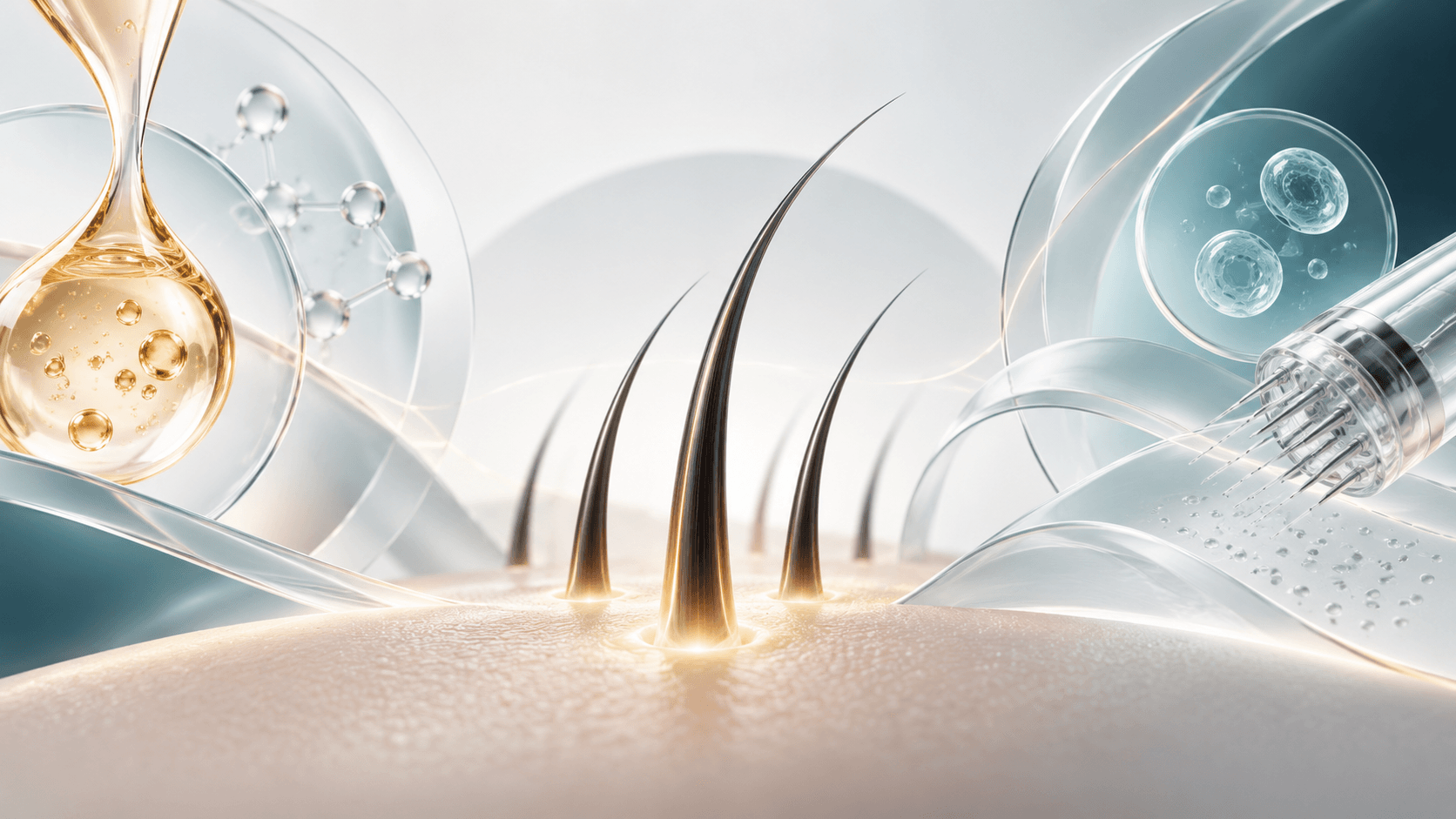
Hair loss can have different causes, from androgenetic alopecia to deficiencies, hormonal changes or scarring conditions. The same procedure therefore does not suit everyone.
In 2026, hair restoration uses both surgical transplantation methods and procedures aimed at supporting existing hair.
Short answer: the main hair restoration procedures include FUE, DHI, FUT, PRP and microneedling. FUE, DHI and FUT involve hair transplantation, while PRP and microneedling are more often used to work with the patient’s own remaining hair.
1. FUE — hair transplantation without a linear scar
FUE, or Follicular Unit Excision, is one of the main modern methods of harvesting grafts for hair transplantation.
During the procedure, follicular units are harvested individually from the donor area using small punch instruments and then transferred to the area of hair loss.
The donor area is most often the back of the head, although in some cases hair from the beard or other areas may also be used.
FUE may be considered when:
- there is androgenetic alopecia;
- the hairline needs to be restored;
- there are bald patches at the temples or crown;
- the patient does not want a linear scar in the donor area.
A 2025 review identifies FUE as one of the two main modern approaches to surgical hair restoration, alongside strip/FUT. (PubMed)
What you should know
FUE does not mean a complete absence of scars. Graft harvesting leaves small dot-like marks, which are usually less noticeable than the linear scar left by FUT. (PubMed)
The result also depends to a large extent on:
- the quality of the donor area;
- the correct direction of implantation;
- hairline design;
- the team’s experience;
- further progression of alopecia.
2. DHI — hair implantation using an implanter pen
DHI, or Direct Hair Implantation, is often advertised as a separate hair transplantation method. Technically, however, it is more accurate to view it as a method of graft implantation, rather than a completely separate method of harvesting them.
In many cases, grafts are first obtained using FUE and then placed in the recipient area with a special implanter pen.
This instrument allows a channel to be created and a follicular unit to be placed at the same time. (PubMed)
DHI may be considered:
- for work on the frontal hairline;
- when precise control of hair direction is important;
- for transplantation between existing hairs;
- when the clinician considers an implanter the optimal way to place grafts.
DHI or FUE — what is the difference?
These terms are not always correctly presented as alternatives.
FUE primarily describes the method of graft harvesting, while DHI usually refers to how the grafts are implanted.
A patient may therefore undergo a procedure in which grafts are harvested with FUE and placed using a DHI instrument.
There is no universal evidence that DHI automatically produces a better result for every patient. The choice of implantation technique depends on the individual case and the surgical team’s experience. (PubMed)
- Treatment & materials
- Hotel nights
- Transfers
- Coordinator-translator
3. FUT — transplantation using a strip of donor tissue
FUT, or Follicular Unit Transplantation, involves removing a narrow strip of skin from the donor area. It is then divided into individual follicular units for transplantation.
Unlike FUE, FUT leaves a linear scar in the donor area.
Despite the popularity of FUE, FUT is not an “outdated” method. A recent 2025 review identifies both FUE and strip excision as current hair transplantation methods. (PubMed)
FUT may be considered when:
- a large number of grafts is needed;
- the patient does not wear very short hairstyles;
- the characteristics of the donor area make this option appropriate;
- the surgeon considers strip harvesting optimal for the particular situation.
FUE or FUT?
The choice should not be based solely on the principle that “newer is better”.
FUE has the advantage of avoiding a single linear scar, while FUT uses a different way of harvesting donor hair. Both techniques have advantages and limitations, so the method is selected individually. (PubMed)
4. PRP — plasma therapy for hair
PRP, or platelet-rich plasma, is a procedure in which plasma with an increased concentration of platelets is obtained from the patient’s blood and injected into the scalp.
Unlike transplantation, PRP does not create new follicles or move hair from the donor area.
It is mainly considered for supporting existing hair, particularly in androgenetic alopecia.
A 2025 systematic review and meta-analysis including 43 randomised studies found a positive effect of some PRP protocols on hair density, although the authors also noted differences between PRP preparation methods. (PubMed)
Other reviews also suggest a potential increase in hair density, but the quality of evidence and protocols remain heterogeneous across studies. (PubMed)
Does PRP replace transplantation?
No.
If an area has already lost a substantial number of active follicles, PRP cannot transfer new hair there.
PRP and transplantation therefore address different needs.
5. Scalp microneedling
Microneedling is a procedure in which controlled micropunctures are made in the scalp using a special device.
It is often used as an additional method for androgenetic alopecia, particularly together with medication.
A 2025 meta-analysis including 12 randomised studies found that combining microneedling with topical minoxidil was associated with a greater increase in hair count than minoxidil alone. However, there was substantial heterogeneity between the studies. (PubMed)
Who may benefit from microneedling?
It may be considered as part of a comprehensive plan for:
- early stages of androgenetic hair loss;
- follicles that remain present but are weakened;
- the need for additional therapy alongside other methods.
Microneedling is also not an alternative to transplantation when an area has already lost a significant amount of hair.
Comparison of procedures
| Procedure | Main purpose | Hair transplantation |
|---|---|---|
| FUE | Harvesting and transplanting grafts | Yes |
| DHI | Implanting grafts with an implanter pen | Yes, as part of transplantation |
| FUT | Harvesting grafts from a strip of donor tissue | Yes |
| PRP | Supporting existing hair | No |
| Microneedling | Stimulation and additional therapy | No |
Which is better: FUE, DHI or FUT?
There is no universally “best” technique.
To make the choice, the clinician assesses:
- the cause of hair loss;
- the extent of baldness;
- donor area density;
- hair thickness and texture;
- the outlook for further hair loss;
- the desired hairstyle;
- previous transplants.
For one patient, FUE with an implanter system may be optimal; for another, FUT may be best; in some cases, transplantation may be premature altogether.
- Treatment & materials
- Hotel nights
- Transfers
- Coordinator-translator
Can the procedures be combined?
Yes.
For example, a patient may be recommended:
hair transplantation + medication
or
PRP + treatment for androgenetic alopecia.
Modern approaches to hair transplantation increasingly include both the operation itself and subsequent treatment to support hair that was not transplanted. (PubMed)
How to understand which procedure you need
It is important to start with diagnosing the cause of hair loss, rather than choosing the name of a procedure.
For example, transplantation may be a good option for stable androgenetic alopecia with an adequate donor area. However, active dermatological or scarring conditions may require treatment of the underlying condition first.
Before the procedure, the clinician may assess:
- the history of hair loss;
- family history;
- the donor area;
- the condition of the scalp;
- the degree of alopecia;
- photographs or trichoscopy;
- the need for additional tests.
How Medikout helps you find a hair restoration clinic
Medikout is not a clinic.
The platform helps patients compare clinics and treatment options suited to their individual case.
The selection may take into account:
- the type and degree of hair loss;
- photos of the donor and balding areas;
- the desired procedure;
- the country;
- the budget;
- previous transplants.
Take the Medikout quiz, describe your problem and add photos — this helps identify relevant clinics and treatment options.
Start with a match, not a random list of clinics
Answer a few questions and see which factors matter for your case
Frequently asked questions
Which hair transplantation method is most popular in 2026?
FUE is one of the main modern graft harvesting methods. FUT is also used, and implanter systems, often called DHI, may be used to place grafts. (PubMed)
Is DHI better than FUE?
Not necessarily. DHI usually describes the method of implanting grafts, while FUE describes harvesting them. They can be used within the same procedure.
Can hair be restored without transplantation?
If follicles are still present, the clinician may consider medication, PRP, microneedling or a combination of methods. If an area has lost a substantial amount of hair, the possibilities of non-surgical procedures are limited.
Does hair transplantation produce a permanent result?
Transplanted hair may retain the characteristics of the donor area, but the surrounding natural hair continues to change with age and the progression of alopecia. This is why long-term planning is important. (PubMed)
Can PRP be used instead of transplantation?
PRP may be used for some types of hair loss, but it does not replace transplantation where follicles need to be physically transferred.
References
- PubMed — Hair Transplantation: State of the Art, 2025
- PubMed — Donor Harvesting: Follicular Unit Excision
- PubMed — Advancements in Graft Placement Techniques
- PubMed — The Pros and Cons of FUE versus FUT
- PubMed — Platelet-Rich Plasma in the Management of Alopecia: Systematic Review and Meta-Analysis, 2025
- PubMed — Microneedling + Minoxidil for Androgenetic Alopecia: Systematic Review and Meta-Analysis, 2025