
A tooth without a nerve: is a crown essential after root canal treatment?
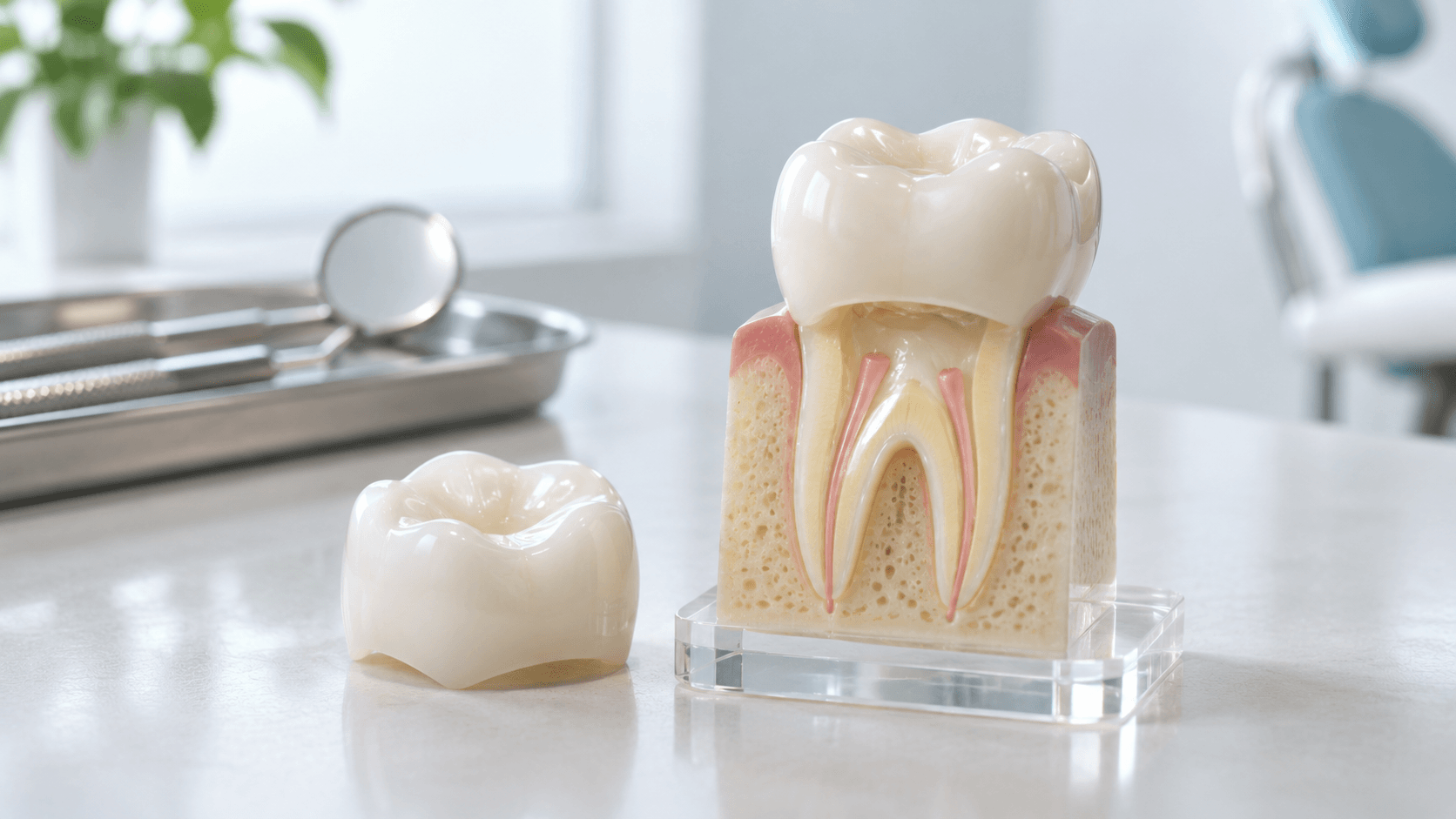
After root canal treatment, your dentist may recommend a crown. But if the tooth no longer hurts, looks normal and lets you chew, a reasonable question arises: why is another procedure needed?
Can you keep an ordinary filling? Does a tooth without a nerve really deteriorate faster? And is a crown worth paying for once root canal treatment is complete?
The short answer: a crown is not always needed after root canal treatment. The decision depends on how much healthy tooth tissue remains, where the tooth is located and the chewing forces it bears.
We explain when a filling is enough, when a crown helps preserve the tooth and which alternatives exist.
What happens to a tooth after the nerve is removed?
Root canal treatment, or endodontic treatment, is performed when the tooth pulp is inflamed, infected or irreversibly damaged.
The dentist removes the affected pulp, cleans and disinfects the canals, then seals them with a filling.
The tooth then loses the sensation provided by the pulp, but remains in the jaw and can still function in chewing.
An important detail: a tooth does not automatically become brittle after root canal treatment simply because the nerve is absent.
The main problem is often the loss of hard tissue through decay, cracks, previous fillings or access to the root canals. The less healthy tissue remains, the harder it is for the tooth to withstand loading.
The European Society of Endodontology recommendations identify preservation of healthy tooth tissue and appropriate restoration as important conditions for long-term treatment success.
Is a crown essential after root canal treatment?
No, not every root-treated tooth needs a full crown.
According to the American Association of Endodontists, the need for a crown depends largely on the tooth's location.
Front teeth with minor damage can sometimes be restored with an ordinary composite filling. Premolars and molars, which play an active role in chewing food, more often need protection of their chewing cusps.
When might a filling be enough?
A filling may be a good option if:
- Most of the tooth's natural crown is preserved.
- The access opening after root canal treatment is small.
- There are no significant cracks or large old restorations.
- The tooth is not subject to excessive chewing forces.
For example, if a front tooth required only a small root canal access opening and its walls remain strong, the dentist may recommend a composite restoration without a full crown.
When is a crown particularly appropriate?
A crown is more often considered if:
- The tooth is severely damaged by decay.
- One or more tooth walls have been lost.
- There are large fillings.
- The tooth is a back tooth used for chewing.
- There is an increased risk of chipping or fracture.
A crown's main purpose is not simply to improve appearance, but to help restore shape and function and protect the remaining tissue.
Crown or filling after root canal treatment: which is better?
The choice depends on the tooth's particular condition, rather than which method costs more.
| Criterion | Filling | Crown |
|---|---|---|
| Amount of healthy tissue | Ideally, enough tissue should remain | May be used when damage is more extensive |
| Extent of intervention | Usually smaller | Requires tooth preparation |
| Protection of chewing cusps | Depends on restoration design | Covers the tooth's crown |
| Appearance | Colour can be matched | Shape and colour can be reproduced |
| Main limitation | Not always suitable for a severely damaged tooth | Requires adequate support and additional expense |
It is important to understand that a crown does not make a tooth invulnerable. Decay can still develop underneath, and the root can crack.
That is why root canal treatment quality, the restoration's seal and regular oral hygiene remain important regardless of the method chosen.
Start with a match, not a random list of clinics
Answer a few questions and see which factors matter for your case
What happens if you do not put a crown on a tooth without a nerve?
That depends on the individual tooth's condition.
If it is well preserved and properly restored with a filling, a crown may not be needed at all.
However, if the tooth has thin walls, large defects or cracks, a lack of adequate protection may increase the risk of complications.
1. Tooth chipping or fracture
Weakened walls may crack or chip during chewing.
Sometimes the damage can be repaired. But if a crack extends deep below the gum or into the root, saving the tooth may be impossible.
2. Reinfection of the root canals
After treatment, the canals need to be reliably sealed off from bacteria in the mouth.
If a temporary filling breaks down or the permanent restoration leaks, bacteria can get inside again.
The American Association of Endodontists lists delays in final restoration and restoration problems among the possible reasons for needing root canal retreatment.
3. The need for tooth extraction
If the tooth deteriorates severely or its root fractures, further treatment may no longer help.
The dentist may then discuss extraction and replacement of the missing tooth, for example with an implant.
However, root canal treatment itself does not mean that the tooth will inevitably need extraction in future. With appropriate restoration and care, it can last many years.
How soon after root canal treatment should a crown be fitted?
You should not delay final restoration for months without your dentist's recommendation.
The restoration plan is usually agreed before or during endodontic treatment, and a permanent filling or crown is fitted as soon as the clinical situation allows.
The exact timing depends on:
- Completion of treatment and sealing of the canals.
- The condition of tissues around the root.
- Any symptoms or complications.
- The need for additional tooth reconstruction.
- The type of crown chosen.
Some patients need temporary protection before the permanent restoration is fitted.
Until the tooth is fully restored, the dentist may recommend avoiding chewing hard foods with it.
According to the NHS, a crown may be needed after root canal treatment, particularly if the tooth was badly damaged.
What if the tooth has been without a crown for several years?
This does not mean every such tooth urgently needs a crown.
If the restoration seals well, the tooth has no cracks, enough healthy tissue remains and it functions normally, the dentist may recommend monitoring or another type of restoration.
However, absence of pain does not guarantee absence of problems.
A root-treated tooth may not respond to cold or heat, but complications around the root and mechanical damage are still possible.
An examination is therefore useful, especially if:
- The filling occupies most of the tooth.
- Chips or cracks have appeared.
- The tooth's colour has changed.
- There is discomfort when biting.
- The tooth has not been checked since root canal treatment.
If necessary, the dentist will arrange X-rays and assess the root's condition.
- Treatment & materials
- Hotel nights
- Transfers
- Coordinator-translator
Are there alternatives to a conventional crown?
Yes. Modern dentistry uses more than just full crowns and ordinary fillings.
Ceramic onlay
An onlay restores the damaged part of a back tooth and can cover its cusps without covering the entire natural crown.
This option sometimes preserves more natural tissue than a full crown.
Endocrown
An endocrown is a single-piece restoration using the tooth's internal cavity for additional retention and does not necessarily need a post in the root canal.
It may be used to restore selected back teeth after endodontic treatment.
A study published in Clinical and Experimental Dental Research in 2026 compared conventional crowns and endocrowns for extensively damaged molars. Its findings highlight the importance of selecting the restoration individually, rather than assuming one method is always better.
Crown with a post-supported reconstruction
If little tooth tissue remains, a post is sometimes used to retain the restorative core.
But importantly: a post does not automatically strengthen the root. Its main function is to retain the restorative structure when appropriately indicated.
The choice between these methods depends on the remaining tooth structure, bite and other clinical factors.
Should a tooth without a nerve be extracted for an implant?
No. Having undergone root canal treatment is not, on its own, an indication for extraction.
If the tooth can be reliably restored, preserving your natural tooth often remains an appropriate option.
An implant is considered when the tooth cannot be restored predictably, for example because of certain fractures, extensive destruction or other serious problems.
Before agreeing to extraction, discuss the possibility of saving the tooth, the treatment prognosis and alternatives with your dentist.
FAQ: common questions about crowns after root canal treatment
Can a crown be fitted to a tooth without a nerve?
Yes. Crowns are often fitted to root-treated teeth if the root and remaining tissue allow a reliable restoration.
Can a filling be enough after root canal treatment?
Yes, in some cases. It depends on the tooth's location, the extent of damage and the forces during chewing.
Does fitting a crown to a tooth without a nerve hurt?
The procedure is usually well tolerated. Although the pulp has been removed, the gums and tissues around the root remain sensitive. The dentist uses local anaesthesia when necessary.
How long can a root-treated tooth last under a crown?
Many years, sometimes decades. There is no single universal lifespan: it depends on the tooth's condition, treatment quality, restoration, hygiene and chewing forces.
Can a crown be fitted if the canals were treated ten years ago?
Yes, if the tooth is restorable. Before fitting it, the dentist assesses the tooth and checks the previous root canal treatment if necessary.
Why does a crowned tooth hurt if its nerve was removed?
Pain may come from tissues around the root or gums, or be associated with a crack, inflammation or bite problems. A dentist must determine the cause after an examination.
How does Medikout help you choose a clinic for tooth restoration?
If a crown has been recommended after root canal treatment, it is important to understand not only its cost, but whether it is truly the best way to preserve the tooth.
Medikout is an online platform helping patients find dental clinics abroad and compare available treatment options.
We help find suitable clinics, review their offers and arrange a free preliminary consultation.
Our partner clinics, including those in Turkey, offer various dental treatments: crowns, restorations, implants and other procedures.
After assessing the tooth, a specialist can explain whether a filling is enough or a crown or another restoration is appropriate.
Would you like to compare tooth restoration options abroad?
Contact Medikout for help choosing a clinic and arranging a free preliminary consultation.
Start with a match, not a random list of clinics
Answer a few questions and see which factors matter for your case
References
- American Association of Endodontists — Root Canal Explained — recommendations on root canal treatment and tooth restoration.
- European Society of Endodontology — The Restoration of Root Filled Teeth — clinical principles for restoring root-treated teeth.
- NHS — Root Canal Treatment — root canal treatment, crowns and restoration.
- American Association of Endodontists — Endodontic Retreatment — reasons for repeat root canal treatment.
- Clinical and Experimental Dental Research, 2026 — Conventional Crowns and Endocrowns — a clinical comparison of methods for restoring molars.