
Why can a tooth decay under a crown even when the crown is intact?
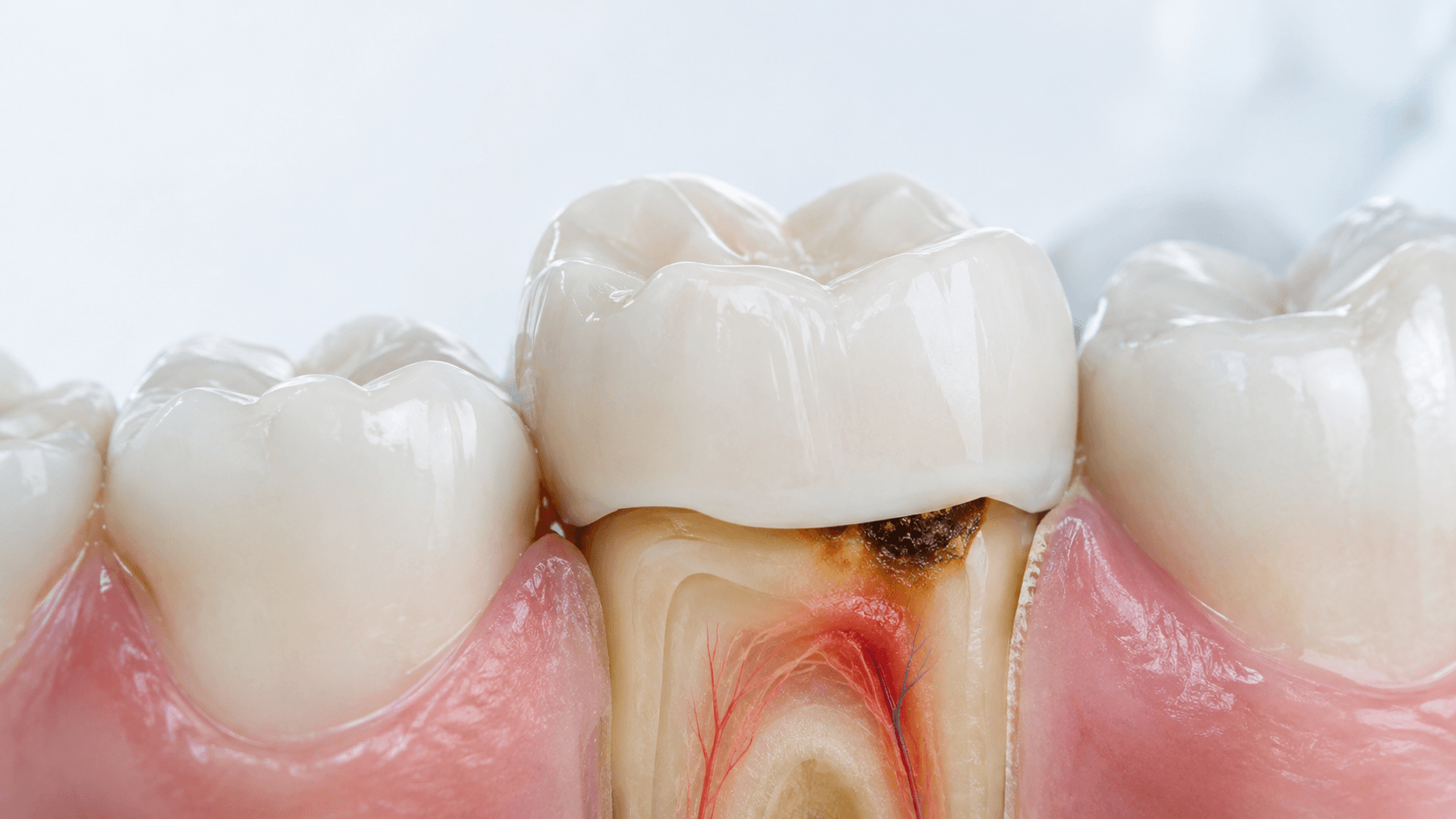
A crown can look perfect years after fitting: no cracks, unchanged colour and normal chewing. Yet decay, inflammation or destruction of natural tooth tissue may develop underneath.
Why does this happen if a crown is meant to protect the tooth?
Short answer: recurrent decay, plaque at the crown margin, poor fit or gum disease can damage the tooth while the crown stays intact. The dentist examines it and takes X-rays if needed.
Can a tooth decay under a crown?
Yes. Natural tooth tissue remains vulnerable even beneath strong ceramic or metal-ceramic restorations.
A crown covers the visible tooth but does not completely protect it from bacteria.
The junction between crown margin and natural tissue, often near the gums, is particularly vulnerable.
Plaque there can cause secondary, or recurrent, caries.
This is a lesion beside an existing restoration.
A review in Clinical Oral Investigations explains that risk depends on margins, hygiene and individual susceptibility, not only crown material.
5 reasons a crowned tooth can deteriorate
1. Recurrent decay at the margin
A main cause is a new lesion where crown meets tooth.
Plaque bacteria process dietary sugars into acids that gradually destroy hard tissues.
Difficulty cleaning the margin raises risk.
The ceramic part may remain undamaged.
2. Poor crown fit
The crown must fit the prepared tooth precisely.
A significant marginal defect can trap plaque and hinder cleaning.
It may relate to initial fitting or later changes in tooth and restoration.
The American College of Prosthodontists notes that open margins and overhangs can increase recurrent decay and gum inflammation.
American College of Prosthodontists
But not every microscopic gap automatically means decay. The dentist assesses the margin.
3. Inadequate cleaning near the gums
Even an expensive crown needs regular care.
Plaque at its edges can cause decay in uncovered tissue and gum inflammation.
Cleaning between teeth is especially important where a toothbrush may not reach effectively.
4. Gum disease
Inflammation or recession can expose part of the root.
These areas are more vulnerable because they lack the enamel protection of the tooth's crown.
Gum disease may also affect supporting tissues.
5. Cracks or other natural-tooth problems
Not every problem under a crown is decay.
Pain may come from a crack, inflammation around the root or other complications.
Even an intact outer crown may cover tissue needing treatment.
Start with a match, not a random list of clinics
Answer a few questions and see which factors matter for your case
How can you recognise a problem?
Early decay under a crown may cause no symptoms.
It is sometimes found only at a routine examination.
Signs to notice include:
- chewing pain or discomfort;
- cold or heat sensitivity;
- an unpleasant taste or smell, particularly from one area;
- bleeding or swelling around the crown;
- a feeling that the crown is loose;
- a visible dark area at the margin.
These do not necessarily mean decay: bleeding can indicate gum inflammation.
Likewise, no pain does not guarantee health.
NHS notes that early decay often has no symptoms, while pain and sensitivity may develop as it progresses.
Facial swelling, fever, pus or severe pain need urgent dental assessment. Difficulty swallowing or breathing requires emergency medical help.
How does the dentist examine the tooth?
A crown hides much of the natural tooth, so visual examination may be insufficient.
Several methods may be used.
| Method | What it helps identify |
|---|---|
| Clinical examination | Gums, accessible crown margins and visible tooth tissue |
| X-rays | Possible decay, root-area changes and hidden problems |
| Fit assessment | Defects at the crown-tooth junction |
| Additional tests | Pain source, pulp and surrounding tissues |
X-rays can reveal hidden lesions, but crown materials may obscure some areas.
The dentist therefore combines imaging and examination.
A study in The Journal of Prosthetic Dentistry found clinical assessment may be more informative than X-rays alone for recurrent decay at crown margins.
- Treatment & materials
- Hotel nights
- Transfers
- Coordinator-translator
Must the crown be removed if there is decay?
Not always.
It depends on lesion location and depth, crown condition and access to damaged tissue.
A localised accessible problem may be repaired without replacing the whole restoration.
Deep decay may require crown removal.
Treatment may include:
- Removing decayed tissue.
- Rebuilding the damaged tooth.
- Root canal treatment if indicated.
- A new crown if the old one no longer fits.
If reliable restoration is impossible, extraction followed by prosthetics or an implant may be recommended.
Decay beneath a crown does not inevitably mean extraction.
International recommendations favour minimally invasive options where possible, preserving healthy tissue.
How can you prevent damage under a crown?
Even a quality crown needs regular care.
Dentists recommend:
- brushing twice daily with fluoride toothpaste;
- daily flossing or suitable interdental brushes;
- limiting frequent snacks and sugary drinks;
- regular dental visits;
- seeking advice if the crown loosens or pain develops;
- professional cleaning as recommended.
Pay particular attention where crown meets gum.
There is no universal replacement deadline. A functional, well-fitting crown over a healthy tooth is replaced according to clinical indications.
How does Medikout help find a clinic abroad?
If planning crowns or replacement abroad, Medikout helps find a clinic matching your needs.
We help compare treatments, obtain preliminary costs and arrange a free partner consultation.
The dentist can assess teeth, tests and whether replacement is necessary.
Medikout selects clinics, not a dental institution. Medical professionals diagnose and treat.
Start with a match, not a random list of clinics
Answer a few questions and see which factors matter for your case
Frequently asked questions (FAQ)
Can a tooth decay under a ceramic crown?
Yes. Ceramic does not decay, but bacteria can damage natural tissue near its margin.
Can X-rays show decay underneath?
Sometimes. Material can limit visibility, so imaging is combined with examination.
Why pain if the nerve was removed?
Root-area inflammation, cracks or other problems can hurt. Removing pulp does not eliminate surrounding-tissue disease.
Must a crown dark near the gum be replaced?
Not necessarily. Discolouration has several causes. The dentist checks margin, gums and natural tissue.
Can decay be treated without removal?
Sometimes, if accessible. Extensive or hidden damage may require removal.
Conclusion
A tooth can deteriorate beneath an intact crown, commonly from marginal decay, plaque or poor fit.
Hygiene and preventive examinations help detect changes early and preserve natural teeth.
Assess tooth and gum health, not just crown appearance.
This article is informational and does not replace medical consultation.